A work friend lent me local author Sharon Irvine's newest book, Close Encounters. Sharon Irvine has published poetry before, but I believe this is her first book of short stories. There are 15 stories in total, following a variety of people as they deal with relationships made out of chance circumstances.
The collection opens with "Road Kill," a story about two people travelling the Trans-Canada Highway between Sault Ste Marie and Thunder Bay. The keep running into one another as they stop along the drive. But their encounters escalate to tragic consequences. I really noticed the rather poetic descriptions in this story (which isn't surprising - Irvine is a poet).
Next was "Einstein: A Sighting." This was a cute story about inquisitive children. The narrator was given the only bed left in the hospital, which was in the children's ward. There she makes some new, younger friends who are curious about the gastric tube she had inserted to clear a blockage.
"Anna" was an interesting (but unfortunately predictable) story about an elderly lady who became friends with the narrator. The elderly lady, Anna, is a fiercely independent woman who takes care of her pet friends (who are all named after literary figures). When Anna breaks her hip, her children want her to move into a home closer to them, which means the fiercely independent woman will have to give up her entire life in Thunder Bay.
"Turkeys 0, Beavers 6" is about a farming family who go out to deal with a beaver dam. The beavers keep rebuilding their dam, flooding the family's best farming field. This was the first story where the narrator was noticeably different; rather than a middle-aged woman, this story was told by a younger boy.
I didn't really like "In the Waiting Room." This was a story about the different people who come into the waiting room of the cancer centre. The end was really unemotional and unattached, which seemed kind of odd with a story like this.
"Dead Dreams" made me particularly mad. It involves a veterinarian (a man, making this another story that stood out due to the difference in narrator) and his alcoholic wife. His wife has diabetes, presumably Type 1 (although she may have been a Type 2 who was insulin-dependent). The husband finds out that she has been having an affair on him; she ends up dying in a hotel room from insulin-overdose while he is off with friends. My issue with this story is that contrary to the author's repeated pronouncement that alcohol raises blood sugar levels, it actually lowers them. So if you were drinking something like vodka or gin straight, you need to eat something to avoid going low. The wife in this story is drinking gin and orange juice. In this case, she would need some insulin to deal with the orange juice, not the gin. So she should not have been pumping herself full of insulin (she actually uses like whole vials!!! It's crazy!!!!) Because of this knowledge (I myself have Type 1 diabetes), I had a really hard time with this story.
"The Loneliness of the Long Distance Swimmer" was a weird tale. I think it was about the crazy things your brain does while bored (in this case while swimming). But the end made it seem like all the craziness actually happened, so I'm not really sure what to make of this story.
"No Exit" was about an elderly couple who end up taking care of their grandson while his mother gets her life back on track. It was a pretty heart-wrenching tale. Other than the expository dump at the beginning, I really liked it.
"Second Chance" was a story about a woman who got stuck taking care of her younger, mentally handicapped brother. She dreams about having a life free from him, but couldn't bear to leave him alone in a home.
"The Tunnel" was a story about two girls who travel to Norway to bike. One of them is claustrophobic and gets scared of a tunnel through a mountain. They make it through just to be confronted with another one.
"Detour" is the story about a young man who grapples with the realization he has to take over the family now that his father has passed away. This story wasn't really anything special because it seemed kind of too similar (at least in themes) to "Second Chance."
"Close Encounters" is about a teacher who teaches a "special" group of boys (most of them are in trouble with the law). One of her students tries to kill her after she sends him to the office for not doing his school work (he will lose his car and pass to go to school).
"Sisters" was a story about two elderly sisters who are complete opposites. But that doesn't stop them from coming together to save a puppy who was cruelly thrown into the river to die.
"The Grief Tourist" is about a mysterious lady who keeps showing up at funerals. Another woman recognizes the lady, and so sets out to discover who she is and why she keeps seeing her at funerals.
The final story, "Lost," was probably the best story of the entire collection. It's about an elderly woman dealing with dementia. She uses post-its to remember everything. She picks up her mentally-handicapped daughter to go to church, but on the way home doesn't recognize their stop. She stays on the bus while her daughter goes for help.
So those were the fifteen stories of this collection. I noticed that a lot of the stories revolve around death and the aftermath of death. I guess that's because death changes things in your life unexpectedly, often in ways you cannot control. Overall, I thought these stories were okay. Unfortunately in a lot of cases it felt like the stories ended rather prematurely, which was a real shame; had they gone further, I think they would have all been much stronger.
Monday, September 29, 2014

Tuesday, September 16, 2014
The Road

The Road tells the story of a father and son who are trying to survive in a post-apocalyptic world. You never know what exactly happened, but the world is a dead place, where no plants grow. Ashes routinely rain from the sky and cover the sun. There's no real mention of how long the world has been like this but you know it's been awhile - everything is ransacked and it's very difficult to find food. Knowing that they won't survive another winter up in the north (wherever they were - I was guessing somewhere like Seattle or Minnesota), the Father decides they need to head south. And so they take their cart and their dwindling supplies, hiking along the roads, scavenging for supplies, and trying to avoid the other people on the road out of fear.
I honestly thought The Road was doomed to be another false start. I started a few weeks ago, got about 50 pages in and then lost interest. But after watching some Walking Dead with a friend (and said friend making the comment that the survivors there have to be eating tons to stay physically fit enough to fight zombies), I found I had a new interest in The Road. Here was a more realistic portrayal of a post-apocalyptic world, one where people don't routinely go to the bra store for clean underwear (it's a running joke my friend and I have while watching The Walking Dead - all the girls have immaculate undergarments!) I had a hard time getting into it, but I am definitely glad I finished it.
Tuesday, August 19, 2014
Daughter of Hounds

I'm going to give a spoiler warning here. I know I wrote on the side bar that I won't bother doing that anymore, but I'm planning on being particularly spoilery with this book. You have been warned.
I had a really, really hard time reading this book. Daughter of Hounds is split between two characters, Emmie Silvey, a strange yellow-eyed girl, and Soldier. Soldier was a human child, stolen from her parents to be raised by the ghouls (so she's a Changeling, aka one of the Children of the Cuckoo). And Emmie was quite obviously a child left in place of a human child. I knew from pretty early on that Emmie was switched for Soldier, even though their ages didn't seem right; I give the book props for what happened to Soldier (her childhood was stolen, so she looked older than she actually was).
I was really torn as I read the majority of the book. I found Soldier's chapters interesting. There was a lot going on with the ghouls and Soldier's Changeling existence that was really interesting. But every second chapter followed Emmie, an 8-year old girl whom I had no real reason to care about. Sure, stuff was happening around her. But nothing really drew me in. It wasn't until the Daughter of the Four of Pentacles (Pearl) actually made her leave the house before she got interesting (and even that wasn't me being interested in her so much as being interested in the story a bit more).
I also didn't like how things would be mentioned, but never really shown in any detail. Like Emmie's step mother had something wrong with her hand. I'm really not sure what happened to her, but it was a detail the book mentioned and then didn't bother to explain. Also, Deacon Silvey (Emmie's dad) was a drunkard who I thought drank because he lost his wife, but might have started because he wanted to dull his psychic powers. That seemed odd, especially when he kept drinking rather than using his psychic powers to go find Emmie once she left the hose. I didn't find this out until after I'd already read the book, but apparently Daughter of Hounds is the third book in a sort of series, so that's probably where some of this came from. But there was a lot that I'd wished Kiernan had gone into more detail with. Which made me laugh in a way, because this book was over 400 pages long. There was room to go into more detail, but it just never really happened.
I don't want to say much more. But this book really wasn't for me. As I've already said, I had a hard time reading this book. Even when it got more interesting (which was around page 200), I still wasn't very invested in the story. So I'm just going to say that this book really wasn't for me, and leave it at that.
Saturday, August 9, 2014
The Naked Face

Wow. Sidney Sheldon's The Named Face is the first book I've read in a long time that's actually on The List. Everything else I've been reading has been library or Kindle books. But hopefully that's going to change over the next while because I'm hoping to stick with mostly books that are in my room taking up space.
So anyway, The Naked Face. This is an older Sheldon book and it really shows: in some ways The Naked Face is quite dated (in language and the idea that homosexuality is something that needs to be/can be cured through psychology/psychiatry). But it's still a Sheldon book, and I have generally liked his books, so I wanted to give it a try.
The Naked Face is about Doctor Judd Stevens, a successful psychoanalyst. When one of Stevens' patients is killed, almost immediately followed by his receptionist, one of the detectives assigned to the case (a man whose partner was killed years ago in a case where Stevens' examination allowed the killer to live) believes that Stevens is the one responsible. Stevens has to figure out who the real killer is before the detective arrests him for murder.
The Naked Face was a really fast read (it's about 300 pages long and I finished it in a day AFTER reading Jonathan Livingston Seagull). It was also a lot of fun trying to figure out who the killer was, although that was tough - you don't actually get the full story until near the end, when Stevens himself figures it out. This is made even harder because you don't actually MEET the killer until near the end of the book. But I was happy that the plot wasn't predictable, and overall I really ended up enjoying The Naked Face.
Jonathan Livingston Seagull

Jonathan Livingston Seagull is a story in three parts, following the main character (the seagull of the title). Jonathan is a seagull quite unlike any other. Rather than simply chasing after food like the rest of the Flock, Jonathan wants to be the perfect flier. But after an almost disastrous landing, Jonathan is named Outcast and sent to live out the rest of his days outside of the Flock. The story is split into three parts: part one is when Jonathan is Outcast, but spends the rest of his days trying to perfect his flying in his physical (and somewhat limited) body. Part two is when Jonathan goes to the next level, a sort of Heaven-like place where seagulls like Jonathan who have transcended their desire for food go to learn the next level of flying. Given a more aerodynamic body, Jonathan is finally at home with other seagulls who are like him (and willing to teach him more of flying!) By the end of this part, Jonathan understands his nature, and is now ready to bring Enlightenment to the seagulls of his old Flock (and in particular, any fellow birds who may have been cast out like he was because they wanted to learn to fly better). So part three is Jonathan doing just that - he becomes the teacher for seven other outcast birds, then talks them into bringing Enlightenment to the rest of the Flock, before going on to teach birds from other Flocks.
While I was reading, particularly in the last part, Jonathan Livingston Seagull really struck me as a Christ-allegory (although that wasn't really fitting - Jonathan repeatedly said he was nothing special. So I guess it was more of an enlightening/empowering every-man narrative?) It is a very inspirational narrative, so if you like that sort of thing, you will like Jonathan Livingston Seagull. Personally I didn't mind the story, but I didn't find it really life-changing (and so feel like it wasn't really meant for me).
Wednesday, August 6, 2014
The Unicorn Sonata
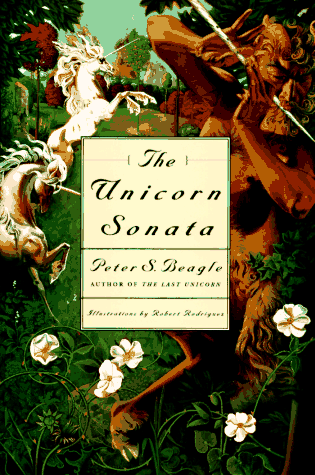
The Eldest were very interesting in this book. There were three "tribes" of them: one described as solid and earthy, one sea-like, and the other was like the sky. They came in a myriad of colours, sizes and shapes, while all remaining unicorns. Their blindness was also interesting, as they could still "see" physical objects in their minds, but they were lessened because they were not whole.
The Unicorn Sonata was an interesting story about a girl torn between two worlds: the magic that is Shei'rah, and the mundane world where her family (particularly her beloved grandmother, Abuelita) is. It is also the story of a talented musician struggling to write Shei'rah's soul into musical notation. While I didn't like The Unicorn Sonata as much as The Last Unicorn, it was still a very interesting and fun read.
Sunday, August 3, 2014
An Exchange of Gifts

Meanne (aka Princess Anastasia de Saumur et Navarre y Cordova) has a Gift entirely unsuitable to a princess: she can make plants grow and create healing potions and salves out of them. So rather than being denied her birthright (and being forced into marrying someone she does not know), Meanne runs away, faking her death so no one will come looking for her. She makes her way to an abandoned cottage she remembers visiting as a child. Unfortunately she didn't realize just how much work living on her own would be.
Luckily, a young boy named Wisp comes to her rescue. He has run away from who knows where, having the scars on his back as a memento. Wisp befriends her, helping to teach her how to survive. Together, the two build an idyllic life, caring for Meanne's plants and snaring small animals.
But after Wisp talks Meanne into going to the local village's monthly market, Meanne's past catches up with her. She faked her death too well, and her father has sent his men throughout the kingdom to find her murderers. But now Wisp knows who she is, too. Things come to a head between them as he finally reveals who he is, what exactly happened to him, and what incredible Gift he has.
An Exchange of Gifts was an excellent read. I loved it enough to buy my own copy from Amazon (along with another of her novellas, If Wishes Were Horses). I can't wait to get them!
Subscribe to:
Posts (Atom)
