Wednesday, May 1, 2024
The Debt-Free Lifestyle
Sunday, August 27, 2023
House Poor No More
I started reading Romana King's House Poor No More back in mid July, and just finished it today. Because of the time it took to finish, it derailed my reading plans a bit, but that's okay - I think it was an important book to be reading right now. I'm at a point where I'm considering home ownership, and didn't want to go into it unprepared.
King's book is not what I originally thought it would be - a book for new homeowners getting into the market. Instead, it is about homeowners of all types being smart about owning a home. I admit that, as a potentially first-time homeowner, I found King's book rather intimidating. It's front loaded with all the things that can go wrong with a house, which honestly scared me quite a bit. Yes, I know that all of these things might not happen, and that it's good to be aware that they can. But as someone thinking about getting into the market, it's a rough start!
That said, King gives a very good overview of what home-ownership entails, looking at everything from repair costs, upgrade costs, insurance, mortgage and debt management, and taxes. This is a Canadian book, so it looks at everything from a Canadian angle, which I was really happy to see as I am Canadian. It's also structured in such a way that you should be able to use the book in the future even if the prices of things continue to go up.
House Poor No More is a fairly dense read though. I found that I couldn't just sit and read it the way I can with some other nonfiction books. I had to read a chunk, then kind of let that settle in before I could continue reading more. That being said, it was very much worth the read! I got this book from the library, but am considering picking it up for myself in the future as a reference!
Sunday, February 20, 2022
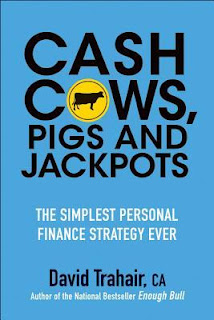
Cash Cows, Pigs and Jackpots: The Simplest Personal Finance Strategy Ever
I picked up David Trahair's Cash Cows, Pigs and Jackpots: the Simplest Personal Finance Strategy Ever at the library the other day. It's been awhile since I've read a personal finance book, and this one sounded interesting. It's also Canadian, which is more relevant for me than American personal finance books, so that was a definite plus.
I thought I'd be in for some fun tales about get rich quick schemes. Or something more akin to JL Collins' The Simple Path to Wealth. Instead, Cash Cows, Pigs and Jackpots ended up a fairly basic personal finance book with only one main message: spend less than you make. While important (but not exactly earth-shattering) advice, that's not really a strategy per se. I've read other books (that I've liked better - check out some of the other personal finance books I've read) that give more details and strategies on how to pay down your debts, and more fun anecdotes from other people taking control of their finances.
Beyond that, Trahair looks at two important aspects of your personal finance: the question of buying or renting a place to live, and retirement. I found that the first discussion got bogged down by him walking you through a spreadsheet he made to help you decide on whether renting or buying is better for you (and since I'm not actively interested in that question at the moment, I wasn't really engaged by it). But I did find the discussion on condos interesting, just in terms of the other fees you need to consider when deciding whether buying one is right for you.
The retirement discussion mainly focussed around CPP and OAS here in Canada. While I was glad to hear that these are healthy and will be around for awhile (particularly CPP), most of the discussion was tied to the specifics of the "new" rules rolled out around 2012. Being 10 years out of date at the time of my reading it, I didn't care at all about these specifics, and so lost interest once again.
All in all, I didn't find Cash Cows, Pigs and Jackpots to be a very engaging read. I would have preferred less focus on the date specific numbers (and honestly less focus on hard numbers in general), and more focus on stories of people (there was one story in chapter four that was really interesting - I would have liked to read more of that in the book!)
Monday, December 30, 2019
Quit Like a Millionaire: No Gimmicks, Luck, or Trust Fund Required
Shen grew up very poor in rural China. She ended up retiring as a millionaire with her husband (Leung) at the age of 31. In Quit Like a Millionaire, she shares her story of how growing up in poverty set her up to save and ultimately join the wealthy. The pair have been retired for three years now, travelling across the world while still maintaining their wealth.
The book starts off by talking about Shen's childhood (including how she went through medical waste trying to make toys for herself) and how her family lived on $0.44 a day. This upbringing left her with a scarcity mindset (when you don't have enough of one of the basic necessities, like food, your brain will ignore almost everything else except that one thing), particularly aimed at money. But after she moved to Canada, graduated with an engineering degree, and joined the middle class, her scarcity mindset, which can't be turned off, changed into a hoarding mindset (rather than changing life-energy for survival, the hoarding mindset trades for nothing). In an attempt to get out of this mindset, especially in the wake of seeing the health of her coworkers deteriorate, Shen discovered the freedom mindset, which is all about getting your time back. And this set her on the path to financial independence and retiring at the age of 31.
The rest of the book explains what Shen and Leung did to build their investment portfolio. And because Shen is extremely risk-adverse, and neither wanted to risk running out of money in the future, they created their own tools to help see them through any potential market crashes within the first five years of retirement (these crucial years, which can make or break your retirement, depend on luck with the market). The book also talks about some potential obstacles to early retirement (like needing health insurance, or retiring early with kids), and finishes off with a few appendices that show her math and spreadsheets, as well as the actual numbers Shen and Leung dealt with through their journey to a million dollars.
Quit Like a Millionaire was a very good and easy read. Shen writes with a very personal tone, making it easy to follow along with her story and points. As far as personal finance books go, I thought this one was a very good read, showing you how anyone can become a millionaire. I liked that despite being American-centric, it still had lots of information specifically for Canadians, too. I'm very glad I picked this book up (and I'm hoping to get myself a copy for reference, too!)
Oh, I'd also like to note, Shen goes through the arguments of why you might be better off renting rather than buying much more succinctly than The Wealthy Renter did.
Saturday, November 16, 2019
Go Green, Live Rich: 50 Simple Ways to Save the Earth and Get Rich Trying
So Go Green, Live Rich was written over a decade ago, when the climate crisis was just coming to mainstream attention (about two years after Al Gore's An Inconvenient Truth came out, just to give it a bit more context). The book is made up of 50 tips to help you save the planet (while also purportedly making you rich in the process). It's broken up into several smaller sections with tips for greening your transportation, family, work, travel, etc. The last two sections detail how to make some money (mainly investing in green businesses), and gifting green (basically tithing to green causes - tithing has come up in both of Bach's other books that I've read so far, so I wasn't surprised to find it here as well).
I'm not going to lie...most of the tips are kind of obvious. Bach breaks down some common-sense things that you can do to both help the environment and save some money. I actually felt like I was reading 397 Ways to Save Money again because there was a lot of overlap (although obviously 397 Ways to Save Money has way more tips), such as swapping out old light bulbs for energy efficient ones, getting newer and more energy efficient appliances when your old ones break down, etc. When Bach got to the family stuff, he also started to remind me of the tips I read in Plastic Purge. So I guess Go Green, Live Rich is kind a combination of Taylor's and SanClements' books.
I did like the breakdowns Bach included though of not only roughly how much money you would save in using his tips but also the impact it would have on the environment (most often in tons of CO2 avoided, but also things like trees saved and stuff like that). But he also included a lot of websites; while I didn't check them all, I'm sure some of the sources are quite out of date since the book is over a decade old (but to be fair, I was able to find the couple that I went looking for, so not all of them are out of date!) Hilariously, the one link I looked for that was obsolete was Bach's own website (greengreen.com, which now just redirects to davidback.com) - I discovered that when I went looking for his reading list of green books (which I have been completely unable to find).
Overall, I think this is a good starting point if you're looking for ways to green your life. It has a lot of the same tips and ideas that are in 397 Ways to Save Money, but it's a faster and easier read. But if you're already on board with living more sustainably, you should probably give this book a pass; it's full of tips you've probably already considered. On the personal finance front, it's also not nearly as in depth as his other books (like The Automatic Millionaire), so you'd be better off reading one of those if that's your interest.
Friday, November 8, 2019
The Wealthy Renter: How to Choose Housing That Will Make You Rich
The first chapter of The Wealthy Renter was also quite promising. Avery says:
You might be thinking this book is about how evil the world of housing is and why no one should ever buy a house.Oh good, I thought. With everyone so down on renting nowadays, I'm excited to read a book that not only sings the praises of renting, but isn't going to be unduly down on home-ownership. Hopefully this is going to have great advice for investing while renting!
It's not.
What this book is, actually, is a celebration of the virtues of renting (13).
Unfortunately, I felt like that passage was a blatant lie. Besides a few mentions of purchasing stocks and bonds, or showing how the stock market outperformed homeownership, the majority of the book just looked down on homeownership. I wouldn't even really call it a "celebration of the virtues of renting" - it basically was just saying "here's all the reasons why buying a home (esp as an investment) is a bad idea." It took until page 164 (out of 189 pages not including the index) before actually talking about the "secrets of the wealthy renter." And the secrets were so underwhelming I was super disappointed (spoiler: some form of forced savings, like automatic payroll deduction - it's the essence of the whole "pay yourself first" - the number one rule of like EVERY personal finance book).
That being said, I was pleasantly surprised to find out The Wealthy Renter was Canadian, so getting facts and figures for Canadian cities and whatnot was quite interesting. And the book still had some very interesting tidbits in it.
I think that if you're someone very firmly in the "renting is throwing your money away" camp, The Wealthy Renter is worth reading to get a secondary viewpoint. It's also worth reading for someone who may feel "stuck" renting due to the high cost of houses - this book does share the benefits of renting, showing that you're not necessarily throwing your money away the way many people believe. Oh, and anyone just interested in a rundown of the costs of owning a home may find the book interesting.
So sadly, while I did get some interesting little tidbits out of it, I was disappointed with The Wealthy Renter. :(
Sunday, September 1, 2019
The Automatic Millionaire Homeowner: A Powerful Plan to Finish Rich in Real Estate
In this quick read, Bach walks you through the process of buying a home, be it your first home or a new rental property. He starts the book with arguments on why it's smarter to buy than rent, gives you some tips on how to get into the market when you don't think you have the money for a down payment. Once you are thoroughly convinced (and if not he recommends you reread some of the chapters), he then looks at the more practical aspects like researching mortgages, interviewing mortgage advisors and real estate agents, and how to pay off your mortgage a few years early, saving you thousands of dollars in the process. He ends the book with a chapter on weathering the inevitable market bust that happens every 20 years or so, and with a final chapter encouraging you to help others become homeowners (through charities like Habitat For Humanity). I actually really like that both this book and The Automatic Millionaire end with chapters on donating time and money to charities; a lot of the financial books I've read are more about accumulating wealth so it was nice to be reminded about the positives of giving, too.
I really liked how thorough Bach was. He really dissected the whole path to home ownership and explained it all in easy-to-understand language. Of course, I was also a fan of the fact that this book is the Canadian edition, so it was more pertinent to me than the American edition would have been. Unfortunately, like The Automatic Millionaire, The Automatic Millionaire Homeowner was written over a decade ago, so some of the websites and other facts may be out of date.
I'd also like to add that this thinking of mortgage as building your assets flies in the face of JL Collins' advice in The Simple Path to Wealth; Collins advocated for not owning and instead investing your money in an index fund. He said that only once you are secure (and wealthy) should you consider buying a home as a luxury.
Thursday, August 29, 2019
The Automatic Millionaire: A Powerful One-Step Plan to Live and FinishRich
Now there's a big caveat to this book: like The Wealthy Barber, The Automatic Millionaire is rather out of date. It was published before tax free savings accounts were available for Canadians (and presumably before ETFs and index funds were around/talked about). So he only talks about RRSPs and mutual funds.
But Bach's advice is still pretty solid. He recommends paying yourself first (at least 10% of your pay). Buying a house. Getting out of debt (especially credit card debt). And tithing (giving money or time to charity). While some of this advice is pretty standard (you can't build wealth if you're saddled with debt), I found the house discussion particularly interesting. Here Bach was saying you can't get rich if you don't own your own house because if you're paying rent, that money is going towards making your landlord wealthy, not to your own net worth (whereas if you're paying down a mortgage, every payment is building equity within your house). This goes against the advice JL Collins gave in The Simple Path to Wealth, but is definitely worth considering.
I also liked the discussion on tithing. It's a short chapter at the back of the book that just talks about how giving attracts abundance (and how giving is very common for people who later became quite wealthy), and also how you should make sure your money is actually going to help the cause you're supporting (and not to administration fees). Again, something worth considering.
Overall, The Automatic Millionaire is another fairly basic book on personal finance. But I think it's still worth reading because now I have more to think about in terms of my own finances (which is always a good thing!)
Friday, August 2, 2019
Happy Go Money: Spend Smart, Save Right & Enjoy Life
I honestly almost stopped reading Happy Go Money part way through because it starts off very much like a self-help book (like You Are a Badass at Making Money was). But after that point, it got into a lot more tangible financial stuff (such as explaining different options for your cash like mutual funds, ETFs, and GICs, or explaining different kinds of insurance and why you might need them). By the end of the book, I was glad that I kept reading; Leong's writing was both practical and lighthearted as the TBPL Off the Shelf article promised. I will offer the caveat though that Happy Go Money is very much for people who are new to the world of personal finance; if you've done some reading on the subject, you may want to give this book a pass because it is very basic.
As a fun side note, I've actually read 2 of the 4 books she recommends in her resource list: Preet Banerjee's Stop Over-thinking Your Money! and Shannon Lee Simmons' Worry-Free Money, which were both excellent. And the other two, The Wealthy Barber Returns and Money Rules, are both already on my list of books to eventually read on the subject! :)
Saturday, March 16, 2019
Beat the Bank
Beat the Bank is very similar to a lot of the other books I've read on personal finance. Bates recommends investing in low-cost index ETF's rather than the much higher cost mutual funds that Canadian banks offer. The majority of the book was dedicated to showing just how much money you lose out to what he terms "Old Bay Street" (through the fees they charge that many investors don't really understand). For that reason it's a very informative book. But because I've already read several other books on personal finance, nothing that he said was really new to me.
That being said, I still enjoyed reading it. I've found personal finance books to be rather interesting to read. In the case of Beat the Bank, because it's so modern, I enjoyed reading about his breakdown of "New Bay Street" - the robo investors and other tools that have popped up with much lower fees than traditional banks. I also really liked that he walks you through the process of buying stocks and bonds; I don't remember any of the other books I've read actually doing that. So Beat the Bank really is a great book for beginner investors. :)
(I'd also like to note that I spoke with someone else at the library who read Beat the Bank, and they really enjoyed it. They said that for a book on financial planning and personal finance, it isn't boring at all, so I definitely think Beat the Bank is a great place to start for beginners and people who think financial books are boring!)
Oh, and I definitely liked Bates' brief discussion on financial plans. It isn't a long discussion, but he talks about the importance of having some sort of target that you're aiming for. Life changes and your target may change along with it, but sitting down and coming up with something that you're working towards is always a good plan.
So that was Beat the Bank. I'm glad I read it, because even though I'm familiar with a lot of the things he mentions, I still learned some new things. :) I think the next financial book I'm going to read is going to be A Random Walk Down Wall Street (that was recommended to me I think in one of the other books I read), but it's going to be a bit before I get to it!
Thursday, September 20, 2018
Millionaire Teacher: The Nine Rules of Wealth You Should Have Learned in School
Millionaire Teacher is Hallam's explanation of nine rules he believes everyone should have learned in school about personal finances. Hallam is a teacher who taught personal finance. He laments that high schools teach advanced geometry but not basic personal finance, so Millionaire Teacher is really his attempt to spread his knowledge. Most of what he says is pretty similar to what other people have been saying in the personal finance books (spend less than you make, invest as early as you can, invest in low-cost index funds). But then he really gets into the nitty-gritty, looking at how you can build your own portfolio, or find good help in building your portfolio no matter where you live (he specifically focuses on the US, Canada, the UK, Australia, and Singapore). He has loads of data that he shares, all backed up by studies. And the studies overwhelmingly support low-cost index funds.
I learned a lot from reading Millionaire Teacher. So much so that my head was left spinning during a few chapters and I definitely feel like I need to eventually reread the book to better take everything in (and also once I have a slightly better understanding of some things he talks about). But don't let my need to reread Millionaire Teacher scare you off: it's a fantastic book on personal finance that I really think every Canadian should read.
Oh wow: as a side note, I have now read Choi's top three personal finance books for Canadians: Millionaire Teacher, Wealthing Like Rabbits, and Stop Over-Thinking Your Money! I don't think I'll be getting through the other two honourable mentions any time soon though because there are a few other finance books I'm interested in reading first.
Wednesday, September 12, 2018
The Wealthy Barber: The Common Sense Guide to Successful Financial Planning
The Wealthy Barber is told as a conversation between three young adults and the title's wealthy barber. When one of the young adults, Dave, asks his father for financial advice, his dad directs him to his barber friend, Roy; it was Roy who taught Dave's father all he knows. Dave, his sister, and his best friend end up going to Roy's barber shop every month for seven months; while the two boys get their hair trimmed, Roy imparts his wisdom on them. The topics include saving 10% of what you earn for future wealth, insurance, saving for retirement, home ownership, general savings, investments, and a few other miscellaneous items like savings for your children's education.
This being the sixth book on personal finance that I've read, some of Chilton's advice was familiar to me. But I still got a few new tidbits for which I am quite grateful for.
The major issue I had while reading The Wealthy Barber was that I got really annoyed with Chilton's three younger adults at the beginning of the book. They kept interrupting Roy as he was explaining things with random questions (yes the questions were generally on topic, but there were a number of times when I thought "shut up and let the man speak!!!") Once you get through the first few chapters this sort of disappeared though - the three young adults were learning and answering more on point questions (or maybe I was just used to it?)
While The Wealthy Barber is a bit dated now (there's no talk of TFSAs, and from what I've gathered his talk of mutual funds is out of date), with its unique conversational structure, I think it's still a great book to read if you're new to personal finances and need some help getting started.
Sunday, July 29, 2018
Wealthing Like Rabbits
Wealthing Like Rabbits is another Canadian personal finance book. Much like the other ones I've read, it's aimed mainly at people who are new to building their wealth. I think it's probably one of the easiest books on the subject to read that I've read to date. Brown has aimed it at young adults (specifically adults thirty and younger); he says this at the end of the book, but it's kind of obvious from his use of things like zombies and Star Trek to illustrate his points.
Wealthing Like Rabbits has a lot of the same advice that the other books have, which can be boiled down to "get out of debt and save money." While his message is the same as the other books, he makes some very interesting suggestions. For one, he recommends that you start an RRSP as opposed to a TFSA (although a TFSA is okay too) because when you are younger you should be more in need of the tax break than when you are older. A younger person is starting their life out, so they may be dealing with buying a home, getting married, and starting a family. When you're older, and if you've been saving all your life, you should be able to afford the tax (especially if you're wealthy enough to be in a higher tax bracket). He recommends that you save 18% of your income in your RRSP (I think that's the maximum you can put into your RRSP), and if you're having trouble doing so, you can fill out a form to have your employer take a corresponding amount of income tax off of your paycheck. Brown believes getting a tax return is not a good thing, because you are in effect lending the government your money and getting no interest for your troubles. A friend of mine at work mentioned this idea to me a few months back; I later found out she read Wealthing Like Rabbits, so I'm sure she got the idea from here. Oh, and Brown says trips are okay to spend your money on (assuming you have saved up for your trip first! You should never go into debt for a trip); I've heard that some financial planning books and advice say trips are not a good investment because unlike buying a camp, the money is gone. In Brown's view, the trip itself gives you memories that are well worth the money. So that was a nice sentiment to read. He feels much the same about weddings - the memories are important, but you don't have to break the bank having one because people don't remember the cost and stuff, they remember the other people who were there.
There was one chapter at the end that was a bit weird to read. It was full of random musings and advice. Yes there were some really good tidbits in it, but there were also a couple of really random thoughts that I'm not quite sure what they were doing in the book (or maybe I just didn't get the references?)
Overall, Wealthing Like Rabbits is a very good read. It's fast and very easy to understand. But some people may not like (or get) his references to things like zombies and Star Trek, so they may be better off reading something else like Preet Banerjee's Stop Over-Thinking Your Money! The Five Simple Rules of Financial Success or Shannon Lee Simmons' Worry-Free Money: the Guilt-Free Approach to Managing Your Money and Your Life instead.
Tuesday, June 26, 2018
Worry-Free Money: the Guilt-Free Approach to Managing Your Money and Your Life
Simmons is the founder of the New School of Finance, which I admit to never having heard of prior to reading this book (and which for some reason I thought was in Vancouver; it's not, it's in Toronto). Simmons quit her job on Bay Street to start her own business; here she shares her tips for getting regular people back on track with their finances (and helps shed light on whether or not you can actually afford certain expenses).
Worry-Free Money is split into three parts. Part 1, Stop Feeling Broke, asks you to look at your life checklist (which you usually mentally compile to keep up with your friends and family - the people you identify with, who Simmons refers to as your Joneses). It also explains how social media can easily exasperate this because you scroll through curated pictures that highlight your Joneses lifes (and which can make you feel envious in a "oh if they can afford that, why can't I?" kind of way). Finally, she makes the case of why you shouldn't compare yourself to anyone - you don't know what their financial situation is like. To go on the trips, get the home renos, etc, your Joneses may be in debt to their eyeballs, or came into an inheritance; you just don't know.
I'm not going to lie: I had a bit of a hard time relating to the first section. I feel like I'm in a point in my life that I'm not quite sure where I'm going, so I don't necessarily have a life checklist. Nor do I feel like I compare myself to other people on social media. It was an enlightening part of the book, but yeah, just not very relevant to me.
But that's okay; part 2, Stop Budgeting, Start Living, and Get Control, is where the fun of the book begins! Simmons advocates getting rid of a budget because budgets set you up to fail, and make you feel bad about every one of your purchases (especially if you come close to or surpass the arbitrary limit you put on each area of your spending). In Simmons' view, life is unexpected and we don't know that we'll spend the same amount on everything each month; some months will have higher expenses in one area than the other. So instead of a budget, Simmons advocates splitting your expenses up into Fixed Expenses (these are your mortgage, utilities, gym memberships, minimum debt payments, etc; basically all of your recurring fees. This should not be more than 55% of your after-tax income), Meaningful Savings (this is where you put more money towards debts, or save for retirement, etc), Short-Term Savings (these are for short term goals like a vacation fund, and buffers for things like car repairs and home renos), and finally your Spending Money/Hard Limit (which includes groceries, gas, entertainment, and all the rest of your expenses). Simmons says you can spend your spending money on whatever you want/however you want to, but do not go above your Hard Limit.
To make things easier, she says it's best to have two accounts: one where you put your Spending Money into, and the other to deal with everything else. Then you can spend your Spending Money down to zero and not be worried about dipping into your other expenses.
Part 2 has tons of examples of how all of this breaks down (using true stories, with permission, from Simmons' clients), talks about how to figure out whether you can afford a Lifestyle Upgrade (this is something bigger that will change your Fixed Expenses permanently, like a bigger house). Part 2 also explains Happy Spending (which is spending that you feel good about both now and in the future) and how your purchases need to both feel good and be affordable. Then she goes into detail about saying no to overspending, and not feeling guilty about saying no to things (and to help you not feel guilty, she advocates about being honest about your finances with other people when you say no; according to Simmons, money is a taboo subject and she thinks that if we change that and start talking about it without judging, the world will be a better place for all).
Part 3, The Future is Financially Friendly (I Promise), has a few chapters about making and adapting to changes in your life (basically you can either spend less or earn more), making the best of a situation when life hands you lemons (when you're dealing with lemons, you may need to look at your life checklist and see if you can make a change so you will be financially safe and so in the long term happier), being realistic about how uncertain life can be (spoiler: have an emergency savings fund that is easy, but not too easy, to access), dealing with financial regrets (you made the best decision at the time that you could with all the information at the time; if you compare yourself to other people, often you forget to factor in their luck), and finally talking about money with your people (without judgement!)
While I wasn't sure about it in the beginning, I honestly really liked reading Worry-Free Money. I liked how Simmons was able to illustrate her points with so many different case studies. Her method is relatively simple. And while I wasn't super fond of her fancy terms at the beginning (Fixed Spending vs Meaningful Savings, that kind of thing), by the end of the book I was fine with it. Oh, and I was really, really thankful that she didn't throw acronyms out all over the place; the only one I can think of was EROI, or Emotional Return on Investment. Simmons' tone is very conversational, which I think worked in a book about financial planning (I don't think Worry-Free Money would work nearly as well if it was written in a formal academic tone, for example - that would be very off-putting to people, myself included).
And by the time I finished reading Worry-Free Money, I had actually busted out some spreadsheets to figure out where I was at financially. Was I spending more than 55% of my income on Fixed Expenses? How much spending money do I really have per month? Can I cut back anywhere to get some short term savings going? (I think that last question is going to require me tracking my spending for a few months). So needless to say, Worry-Free Money is a very inspiring book; I recommend it for everyone who has worried about their spending habits (which I'm sure is most people), or for people trying to figure out if they can REALLY afford something.
Sunday, June 24, 2018
397 Ways to Save Money: Spend Smarter and Live Well
Monday, June 11, 2018
Stop Over-Thinking Your Money! The Five Simple Rules of Financial Success
Banerjee has five simple rules (which are hard to implement):
- Disaster Proof Your Life
- Spend Less Than You Earn
- Aggressively Pay Down High-Interest Debt
- Read the Fine Print
- Delay Consumption
The other two rules were eye-opening though. I've never thought about getting disability insurance or life insurance before. But statistically 1 in 3 Canadians will be off of work for a few years in their lifetime, so disability insurance really makes sense. And life insurance definitely makes sense if you want to make sure your family is taken care of after you die. The other rule also makes a lot of sense - read the fine print so you aren't surprised by anything (like in his examples where someone thought they had insurance coverage, but in fact they did not).
After the rules, Banerjee goes into a bit more detail on investing, finding a financial advisor, and insurance. I will admit, some of these chapters were a lot harder to understand than the first few (but I will also admit that I mostly read this book late at night while I was sleepy, so that most definitely didn't help). Banerjee's discussion of financial planners was really good though; he advocates for a proper financial advisor who will help you with an overall financial plan, whatever your goals.
Banerjee finishes off the book with a bigger discussion on Insurance. It was really interesting looking at how the companies come up with their premiums (and why premiums go up as you age).
A major flaw of this book was that there was no bibliography or further reading list. Banerjee throws out a bunch of book recommendations that I had to write down on the spot because there was no handy list to refer to or photocopy at the end. But at least now I've got a bunch more books I want to read!
Overall, I thought this was a great book on personal finances for Canadians, particularly people who are just starting out thinking about saving and don't know where to start. His rules are simple, but do be prepared: they can be hard to implement.
Saturday, May 26, 2018
The Simple Path to Wealth: Your Road Map to Financial Independence and a Rich, Free Life
Collins' approach is pretty simple: he says most people are in either a wealth accumulation phase of their life or a wealth preservation stage (and you can go back and forth between the two as your life circumstances change). To accumulate wealth, he recommends getting rid of debt (that's a giving), and investing heavily (50% of your income if you can!) in a stock index fund (he recommends Vanguard's VTSAX). The index funds are a safer bet than trying to predict the outcome of buying individual stocks. If you're trying to preserve your wealthy, he recommends adding some bonds into your portfolio to smooth out the ride a bit (once again, he recommends Vanguard's VBTLX). Why the recommendation of Vanguard? The company was created by Jack Bogle; he believed that an investment firm's interests should be aligned with the interests of its shareholders. In contrast, many companies' interests do not align with shareholder interests (the companies want to make as much money for themselves as possible).
That is literally his advice. It is simple, but it takes a lot of hard work - you will have to restrict your spending habits in order to save. But the end result is worth it. And you will have achieved financial independence when you can live off of about 4% of your assets (so if you live off of say $20,000 a year, you would need $500,000 invested).
I honestly enjoyed Collins' writing. Pant really wasn't lying about The Simple Path to Wealth - Collins has made managing money a relatively easy to understand process. The only major complaint that I had with the book was that Collins is American, so some of his advice focuses strictly on American accounts (and I will admit, when he started getting into the nitty gritty of the various American accounts that were available, I felt my eyes glazing over). Be that as it may, his advice is still solid, no matter where in the world you may live. You just may have to use other accounts or funds to grow your wealth.