Pages

Showing posts with label writing. Show all posts

Sunday, January 23, 2022

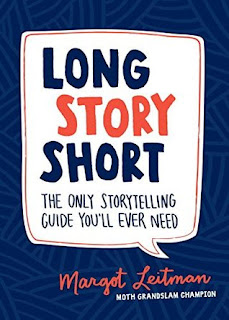
Long Story Short


I bought Long Story Short: the Only Storytelling Guide You'll Ever Need by Margot Leitman last year, during a writing book buying-spree I went on. Apparently I didn't pay too much attention to it though, becauae it's actually a book about oral storytelling rather than writing. But that was okay - I found Leitman's writing super engaging, and some of her principles do translate to writing stories as well.

Long Story Short is a guide on how to tell true stories from your life to an audience, whether that is during a storytelling competition, as part of your work, or even just to a group of friends. Leitman discovered storytelling by accident when she was an aspiring actress in New York. Since then, she's told her stories on national television, won storytelling competitions, and started teaching others how to tell their true stories. While she covers the basics of crafting a story (specifically looking at things like condensing characters, and making sure your story has a beginning, middle, and end), the majority of the book is focussed on either finding your story, or on giving you the confidence to tell your story (and to tell it truly - don't embellish it!) 

Long Story Short is a super quick read (it's also a really cute little book). As I said, I really enjoyed Leitman's writing - you can tell she has a real knack for storytelling! I also liked how it gave great ideas for actually presenting stories - the next time I have to do any sort of presentation, I'll definitely be giving this book another read!

Sunday, August 15, 2021

Narrattive Designer: Fabulator Ludus


Narrative Designer: Fabulator Ludus by Stephen E. Dinehart IV is a deceptively small book.  At a little more than 100 pages, it is packed full of very dense ideas on narrative design and storytelling more generally.  I will not say too much about it because I feel like it is the type of book that you need to read a few times to reach a better understanding.

But I do wish the book had a glossary.  It would have been very helpful!

Sunday, March 29, 2020

Writing Subtext: What Lies Beneath

So I started reading Eldest, but then decided to put it aside yesterday in favour of Writing Subtext: What Lies Beneath by Dr. Linda Seger. It's a writing book I've been meaning to get to for quite some time now, and I thought it would be particularly helpful for the RPG I'm currently working on too.

In scriptwriting, when characters say what they mean, that's considered "on the nose" - or the text.  Dr. Seger urges writers to go deeper, using the subtext (or the deeper meanings to what characters are saying - their words are not taken at face value). 

The main part of the book is split into 6 chapters (there's also another writer's perspective on subtext, and an afterword).  After exploring in detail what exactly she means by subtext, Dr. Seger then gives writers a number of ways to bring subtext into their own writing (through characters, words, gestures, similes/metaphors, and through genre).  It's a very thorough examination of the topic in such a small book (I read it in a day, although I did not do the exercises that were included at the end of every chapter).  Writing Subtext was a very good book that I'm glad I read - it's really given me a lot to think about in my own writing!

Saturday, December 1, 2018

Will Write for Food

I wanted to write a recipe for an upcoming blog post on another blog.  I realized I had no idea how to write a recipe....so I read an entire book on food writing!!! lol

I've had Will Write for Food: The Complete Guide to Writing Cookbooks, Restaurant Reciews, Articles, Memoir, Fiction and More... by Dianne Jacob for years now.  I believe I bought it back in university, when I used to wander into the bookstore to see what interesting writing books they were selling (I'm guessing that was around ten years ago or so...).  I'd never really thought about specifically writing about food, so this sounded like an interesting read.  Then it sat on my shelf for years because I don't really write specifically about food all that often.

Will Write for Food goes through quite a few topics in such a short book.  As the subtitle suggests, Jacob looks at restaurant reviewing, writing cookbooks and recipes, food memoirs, other nonfiction books, and fiction. She also has some chapters for getting started, freelancing, and getting your book published.  The book focuses on food writing, so in terms of these more general topics she includes advice and a starting point, then gives suggestions of other books you should read to learn more.  Will Write for Food is also packed full of discussions and advice from other food writers, chefs, and even editors and agents.  I should note that I have the 2005 edition of the book; there's an updated 2015 edition that will be less dated than this one was (I think the 2015 edition includes writing for blogs, which would have been handy for me).

If you want to write about food, this is definitely the book for you.  Jacobs is a teacher who wanted a reference book available for people trying to break into the industry, and her knowledge and passion for the subject clearly shows.  I also really liked how she brought in other expert's perspectives to all of her topics. 

Even if you're not planning on writing about food, learning about how it is done is rather fascinating.  The chapter on restaurant reviewing was particularly eye-opening in explaining how often reviewers must eat out (some even have to schedule their meals into their calendar just to keep track of where they're going!) and the lengths some of them have gone to try to remain anonymous.  I admit I have no interest in such a thing after reading this chapter!!!

I did find the initial chapters to be a bit of a slog though.  I didn't pick this book up to learn about becoming a writer; I was more interested in the nitty-gritty details about actual food writing (and Jacobs discussion of passion made me wonder why I was even reading this book because I'm not particularly passionate about food). But once I got through these chapters I thoroughly enjoyed reading Will Write for Food.

Friday, May 4, 2018

Naked, Drunk, and Writing: Shed Your Inhibitions and Craft a Compelling Memoir or Personal Essay

Naked, Drunk, and Writing: Shed Your Inhibitions and Craft a Compelling Memoir or Personal Essay by Adair Lara is a writing book I've had FOREVER that I just never got around to reading.  I've tried reading it here and there over the years, but for some reason never got very far.  I'm not interested (right now anyway) in writing a memoir, but I would like to learn more about personal essays, which is why I kept attempting to read it.  I finally buckled down and actually read the whole thing (even the stuff about memoirs) over the last few weeks.

Lara is concerned with both personal narrative essays and memoirs (which are basically longer personal narrative essays).  She starts the book off with the essay, talking about how to craft one, coming up with your angle, your tone, and using images.  She takes a break to talk about getting yourself to write and the value of writing buddies before moving to talk more in depth about writing memoirs.  While I'm not interested in writing one myself, I found her discussion of memoirs quite interesting, especially since I was also reading Cait Flanders' memoir The Year of Less (and it was, in my opinion, full of all the things Lara said NOT to include in your memoir - like making yourself out to be the victim and not having a satisfying conclusion - your memoir should be you looking back at the events long after they have ended, not you looking back at events while still in the middle of things).  If I hadn't read Lara's book, I don't know if I would have been able to put my finger so easily on why exactly I didn't like Flanders' book.

That being said, I still feel like I'm floundering a bit as to the writing of a personal essay.  Her advice on the actual crafting of it didn't quite gel in my mind.  I'll probably have to give it a try and/or reread that chapter another time before it does.

Tuesday, October 10, 2017

Write a Western in 30 Days: With Plenty of Bullet-Points!

Write a Western in 30 Days: With Plenty of Bullet-Points! by Nik Morton was an interesting read. I've never written a Western, and I was intrigued by how he proposed to do it in 30 days. (Spoiler on that front: he considers every 8 hour chunk a "day," and sets out a rough guide as to how much you should write per day). I loved the early chapters of the book, which detailed facts about the Old West. I started losing interest though once the book moved into the nitty gritty of writing. I think this was because these aspects of the book were written for beginner writers; in my case, I've heard the advice before. But I persevered and made it to the end (although I admit that I totally skimmed the appendices). The book also made me interested in reading Morton's The $300 Man, although I probably won't because he gives away most of the plot points here (except for the very end). All in all, Write a Western in 30 Days is a solid writing book, particularly for beginner writers and anyone interested in writing a Western quickly.