Pages

Sunday, April 24, 2022

Own Your Morning: Reset Your A.M. Routine To Unlock Your Potential


My mom sent me a link with information from Liz Baker Plosser's Own Your Morning: Reset Your A.M. Routine To Unlock Your Potential as a joke.  I've never liked getting up and have never, ever been a morning person.  But after reading through the article, I decided to pick the actual book up on my tablet (yay Google Play Books!) and give it a read.  I ended up choosing my tablet because a lot of the reviews said the book was structured like a magazine, so I thought it would be better to read there than on my Kindle.

Own Your Morning talks about ways to make your morning better for you.  The book is very aware that everyone's morning will be different because we all have different lives and personalities, which I really liked.  One of the early chapters was all about finding your (current) values, and trying to honour at least a few of them in your morning, which will set a better tone for you during the rest of the day.  From there, it examines various aspects you might want to include, such as exercise and meditation, and talks about some of the benefits of each of these.

Unfortunately, as the reviews that suggested Own Your Morning would be better on a tablet kind of suggested, the book is a little light on details.  While this makes it a very fun and easy read (which was great - I've been having trouble lately sitting down and reading stuff, so having a quick read was perfect for me right now), it does not go into depth on any of these topics.  So if you're looking for a fun overview of things, it's good. But if you were hoping for more depth, you might not be happy with Own Your Morning.

The other feature of the book that I really liked was the interviews with different women who talked about their morning routines.  While this really drove home the idea that everyone's morning is different, the interviews also gave some fun different ideas for what your morning can look like.  

All in all, I really enjoyed reading Own Your Morning.  I'm going to have to look at tweaking my own mornings, especially on work days.  Maybe incorporating some of the tips I learned here will really help me own my mornings, too.

Sunday, April 3, 2022

The Deep


 I've been wanting to read The Deep for awhile now, but finally sat down to read it a few nights ago.  It tells the story of a mermaid (Yetu) who, as the historian, holds all the memories of her people, of their trauma and how they came to be. While she is gifted, she is also extremely sensitive, and the memories are literally killing her. So when the time comes, as it does every year, to let her people remember, she decides to run and save herself, rather than take the memories back at the end of the ritual (and so die).  While she slowly regains herself and her sense of self away from the memories, she becomes increasingly aware that the memories are killing the rest of her people, and so needs to decide whether to live or to save them all.

I really enjoyed The Deep.  I loved the worldbuilding around where the merpeople came from (they are descended from pregnant African slaves who were thrown overboard - the idea is that in the womb, babies are not breathing air, so what if they were born of the sea and never needed to breathe air? A very interesting narrative that has roots in songs - this article talks a bit about it, as well as the idea that people would like a memorial along the Atlantic trade routes, which is definitely deserved considering how many people died along them)  And the idea of holding all the trauma from generations of your people (and it wasn't just the trauma, it was their actual memories) was really interesting - as historian, Yetu wasn't really living, she was living the lives and trauma of all the people who came before her.  

Definitely check it out if you have the chance (and are okay with reading fantasy)!

Sunday, February 20, 2022

Starless


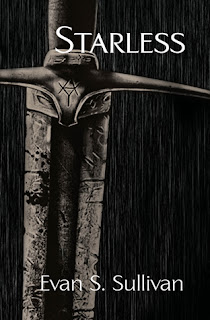
Starless is a short fantasy novella by Evan S. Sullivan telling the story of Calan Castillon. It goes back and forth between his youth and ten years later when he is part of an invasion to another land.  The other land, Cavadere, invaded their lands during his youth and Calan's father was killed during the war to repel the invaders.  Now the kingdoms who were invaded have created their own great fleet and strike out to conquer the enemy who invaded them.  Calan was sent to honour his family's alliance with another kingdom, and Calan is incredibly resentful that his family abandoned him like that.

I had a really hard time connecting with Calan.  Some of the things that happened, particularly in his youth, seemed really weird to me (I'm not positive how old he was, but he was able to wander around his city freely without an escort around the age of 8 or 9, and he's the nephew of the king).  He didn't seem to understand how alliances work even though the book said he had political training once he was a bit older.  And he was kind of just generally sullen, unlikable, and not particularly useful in the events of the story (his commanding officer disliked him and I actually found myself agreeing with the commander because through the early parts of the story, Calan was mainly standing around and doing nothing - though I will concede that this part of the story took place on a boat, and Calan says he has had no experience on one before).

Starless is a fairly short read (about 110 pages).  I mention this because it felt like the story actually started around page 70 or so.  Most of the things that happened before that were backstory that wasn't particularly needed; with the story coming from Calan's perspective alone, we could have taken his word on what he was feeling towards everyone else, particularly in his family, without the events needing to be shown.  Even the events that fueled his nightmares weren't particularly needed for the narrative itself.

I did find the ending of the book to be interesting though.  I admit that I clued in on what was most likely going to happen around page 70, but was still curious to see how it all unfolded and why.  Calan reminded me of Arthas from Warcraft III in many regards with what happened in Starless, though their stories are by no means the same.  

I was also intrigued by many of the other characters surrounding Calan.  His cousins seemed particularly interesting (the princess heir to the throne who can apparently best two grown men/knights with a sword, and her younger brother who just wants to be a musician, not a prince) and it was a shame that this story didn't show more of them.  I also wish the differences between the kingdoms had been explored in more detail (why do the women of the South get to use swords when the women of the North don't?), although I do understand there wasn't space for such things within Calan's narrative.  I am hopeful that more of these characters and cultural differences will be explored in Deathless, Sullivan's new novel that I believe is set in the same world as Starless.

I'd also like to mention that the list of characters really came in handy when I started reading Starless, particularly in terms of the Castillon family (the king, his son, and his brother all have names starting with "R," so it took a bit to figure out who was who).  I do wish there had been a map though to show the different kingdoms, particularly while trying to follow the events of the war. I firmly believe that fantasy books should all have maps to help the reader follow along.

Cash Cows, Pigs and Jackpots: The Simplest Personal Finance Strategy Ever


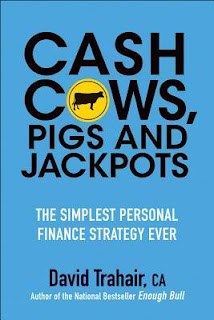
 I picked up David Trahair's Cash Cows, Pigs and Jackpots: the Simplest Personal Finance Strategy Ever at the library the other day.  It's been awhile since I've read a personal finance book, and this one sounded interesting.  It's also Canadian, which is more relevant for me than American personal finance books, so that was a definite plus.

I thought I'd be in for some fun tales about get rich quick schemes.  Or something more akin to JL Collins' The Simple Path to Wealth.  Instead, Cash Cows, Pigs and Jackpots ended up a fairly basic personal finance book with only one main message: spend less than you make.  While important (but not exactly earth-shattering) advice, that's not really a strategy per se.  I've read other books (that I've liked better - check out some of the other personal finance books I've read) that give more details and strategies on how to pay down your debts, and more fun anecdotes from other people taking control of their finances.

Beyond that, Trahair looks at two important aspects of your personal finance: the question of buying or renting a place to live, and retirement.  I found that the first discussion got bogged down by him walking you through a spreadsheet he made to help you decide on whether renting or buying is better for you (and since I'm not actively interested in that question at the moment, I wasn't really engaged by it).  But I did find the discussion on condos interesting, just in terms of the other fees you need to consider when deciding whether buying one is right for you.

The retirement discussion mainly focussed around CPP and OAS here in Canada.  While I was glad to hear that these are healthy and will be around for awhile (particularly CPP), most of the discussion was tied to the specifics of the "new" rules rolled out around 2012.  Being 10 years out of date at the time of my reading it, I didn't care at all about these specifics, and so lost interest once again.

All in all, I didn't find Cash Cows, Pigs and Jackpots to be a very engaging read.  I would have preferred less focus on the date specific numbers (and honestly less focus on hard numbers in general), and more focus on stories of people (there was one story in chapter four that was really interesting - I would have liked to read more of that in the book!)

Saturday, February 5, 2022

The Secret History of the Mongol Queens: How the Daughters of Genghis Khan Rescued His Empire


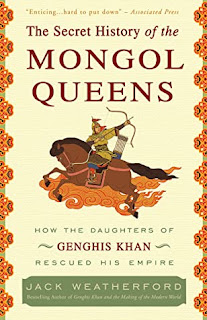
I picked up The Secret History of the Mongol Queens: How the Daughters of Genghis Khan Rescued His Empire by Jack Weatherford a few years ago, on a whim.  I don't know a whole lot about Mongolia or Genghis Khan, but I was intrigued that his daughters might have had a hand in saving the empire he built.  

The Secret History of the Mongol Queens is split into three parts.  The first part was centered around Genghis Khan himself, showing how he built his empire and why his daughters played such an important part in it (he had been betrayed by many men throughout his life, and he needed someone he could trust running things while he took the men off to war).  I found this part quite fascinating, especially with just how much power he gave his daughters.

The second part was, in my opinion, the hardest one to get through. This showed how, after his death, the men of his clan undermined and stole power from the women.  There are some very dark events covered in this section (I'm not going to lie - a few events I wish I could go back to not knowing about - hopefully they will fade from my memory soon). But there were some really interesting people in this section, like Qaidu Khan and his daughter, Khutulun.  Khutulun was a fierce warrior, and she vowed to only marry a man who could beat her at wrestling.  While she did end up marrying someone eventually (in the wake of rumours that spread about her and her father having some sort of incestuous relationship), she was undefeated in wrestling!

The final section was about Manduhai and Dayan Khan.  Manduhai ended up a queen put in an almost impossible situation after her husband passed away, because whoever married her would become the next Khan.  But rather than marrying one of the three obvious contenders, she forged her own path by engaging herself to a child who was the final male heir of Genghis Khan.  And rather than using him as most others might have, she ensured that he grew up to be a strong and wise leader, making sure that he was always along when she brought the Mongols to war.  Together, the two of them reunited the shattered empire of Genghis Khan for good, while also ensuring that the surrounding countries understood that they had no interest in conquering more territory - the Mongols had learned that it was hard to administer a vast Empire. Though there was about 20 years between them, Manduhai and Dayan Khan stayed together until her death; neither of them took another spouse or tried to depose of the other (although they very easily could have gone their separate ways once Dayan Khan was 18).  

While overall The Secret History of the Mongol Queens was an interesting book, I did find the writing to be a bit dry at times.  I also thought it would have benefitted from a lot more supplemental material, especially lineages.  I found I had a really hard time keeping people straight, particularly in the second section of the book where it moved quite quickly from person to person.  This was also the section that did not have any family tree at all when it began.

I'd also like to mention the really neat calligraphy drawings at the beginning of each section.  I didn't realize that's what they were until I read the Acknowledgements page - they are by N. Bat-Erdene, and they depict three of the Mongol Queens (Borte, Sorkhokhtani, and Manduhai). According to Weatherford's note, the Mongol people believe the essence of a person survives in the sound of the spoken name and the form of the written one, hence why these drawings are particularly important.  He also notes that no portraits of these ladies are known to exist.  Very, very interesting!

Saturday, January 29, 2022

Jurassic Park


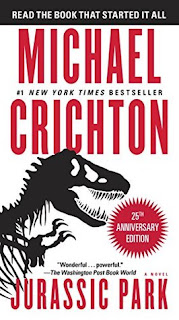
I've considered reading Michael Crichton's Jurassic Park on and off over the years.  I love the Jurassic Park movie.  I also really, really liked Crichton's book Timeline when I read it years ago (before this blog existed. I thought it was the only Crichton book I've read, but I also apparently read Next over a decade ago; I don't remember it at all).  But I never got around to it.  I think I had a paperback copy for awhile, then got rid of it.  But then a few months ago I was talking to a friend about it and ended up picking it up on my Kindle.  My friend really liked it, and recommended it as a must read for dinosaur lovers.  

The movie follows the overall plot of the book fairly well, so if you've seen it, you know what happens.  Dr. Grant, Dr. Sattler, and Ian Malcolm are all invited to John Hammond's island to tour his amusement park.  The lawyer, Donald Gennaro, wanted their help in assessing whether or not to close down the park.  Hammond also invited his grandchildren to the park in the hopes that their presence would help Gennaro see the wonders the park gave to children.  

The characters are a bit different from the movie though.  Lex is only 7 or 8 and a tomboy (and a very stereotypical annoying kid).  Tim is older and into computers as well as dinosaurs.  There's a PR person who takes them around on the tour.  And Dr. Settler (who is much younger than I would have thought) seems to mostly be present as an audience for Ian Malcolm's lectures.

They're also....kind of flat.  And honestly not particularly interesting people (I think because they're flat). 

There's also a lot of science throughout the book.  In Timeline, I remember the science being front heavy - once you got through the first bit, the science was all explained and the story just happened.  In Jurassic Park, the science is throughout the book, often halting the story to be explained.  And it's not just one kind of science: you've got genetics, paleontology, biology, chaos theory mathematics, computer science (the book hasn't aged particularly well in regards to the technology - it was written at a time when CD players needed to be explained in detail).  

Also: misogyny.  Everyone is so surprised that Dr. Sattler is a woman.  But then she gets to just do stereotypical woman things (go help take care of Dr. Malcolm while us men figure everything out), forgetting that she's just as smart as the men in the room.  It really bothered me knowing how great and active she was in the movie (a lot of the things she does in the movie are done by Gennaro in the book).

So all in all, I found Jurassic Park to be quite the let down.  But now I want to go and rewatch the movie, which I think is far better paced than the book was!

Sunday, January 23, 2022

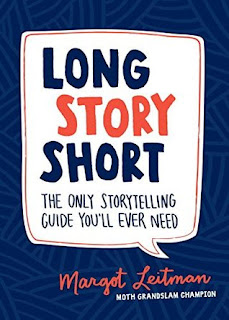
Long Story Short


I bought Long Story Short: the Only Storytelling Guide You'll Ever Need by Margot Leitman last year, during a writing book buying-spree I went on. Apparently I didn't pay too much attention to it though, becauae it's actually a book about oral storytelling rather than writing. But that was okay - I found Leitman's writing super engaging, and some of her principles do translate to writing stories as well.

Long Story Short is a guide on how to tell true stories from your life to an audience, whether that is during a storytelling competition, as part of your work, or even just to a group of friends. Leitman discovered storytelling by accident when she was an aspiring actress in New York. Since then, she's told her stories on national television, won storytelling competitions, and started teaching others how to tell their true stories. While she covers the basics of crafting a story (specifically looking at things like condensing characters, and making sure your story has a beginning, middle, and end), the majority of the book is focussed on either finding your story, or on giving you the confidence to tell your story (and to tell it truly - don't embellish it!) 

Long Story Short is a super quick read (it's also a really cute little book). As I said, I really enjoyed Leitman's writing - you can tell she has a real knack for storytelling! I also liked how it gave great ideas for actually presenting stories - the next time I have to do any sort of presentation, I'll definitely be giving this book another read!