Pages

Showing posts with label science fiction. Show all posts

Wednesday, April 22, 2026

Operation Bounce House

Someone recommended Matt Dinniman's Dungeon Crawler Carl to me a little while ago. While waiting to get a hold of it from the library, his newest book, Operation Bounce House, came out, so I decided to give that a try.

In Operation Bounce House, the people of New Sonora become the target of a corporation's new game, Operation Bounce House, where human players can pay to build mechs and fight against the evil "New Sonoran terrorists." Only....there are no terrorists, just a bunch of farmers who are trying to peacefully live their lives. But unknown to the game's creator, Oliver Lewis and his sister still have functioning bots who help them on their farm, including an advanced AI named Roger who coordinates the worker drones. And after they come under attack, Roger initiates their defensive mode. These farmers aren't going to just lay down and die while Earth steals their land: they're going to fight!

While I, overall enjoyed Operation Bounce House, I have to admit that the premise and plot made me very uncomfortable. I can see something like this happening, potentially even here on Earth right now. The way the Earthers talked about the New Sonorans being "other" and "subhuman" is a known propaganda tactic used in wars (I remember reading about how soldiers in the World Wars would call the enemy by different terms to make them not-human in their heads). So yeah, be warned if you're reading this book: it is very uncomfortable at times. 

 Plus, you know, a lot of people die. It's not a happy book.

But as I said, I still did enjoy the book. Dinniman is a really good writer, particularly in a cinematic sense: I could picture the action really well (and think this would make a fantastic TV series or movie). I loved all the characters and how they all worked together to try to stay alive (and how they decided to stick it to the game company). The worldbuilding was really interesting, how the main characters were part of the "orphan generation" because all their parents who were born on-world died (and how the fix ended up the thing the Earthers used to claim the New Sonorans were "subhuman," even though they were the same with the exception of that one change in their genes so that they wouldn't die like their parents did). 

I also liked how so much only happened because the Earthers were terrified. The very thing they feared would happen did happen only because they attacked New Sonora. Had they left the planet alone, nothing would have happened.

Operation Bounce House is a fast, addicting read (I stayed up really late to finish it last night). If you're okay with the dark subject matter, it's definitely worth checking out. But do be aware of the subject matter as it is an uncomfortable look at where our culture could go.

Thursday, March 5, 2026

Automatic Noodle

Automatic Noodle
by Annalee Newitz sounded like a super fun read. A group of robots wake up after being deactivated for a few months in the restaurant they were working in. They decide to open their own restaurant, even though they know they're technically not allowed to own property or businesses (or even own a bank account). So with the help of one of their human friends from before they were deactivated and a sentient car, they decide to start making the best hand-pulled noodles they can. But after some anti-robot activists get wind of their restaurant and start review-bombing them, how will their restaurant dream survive if no one can find them on the restaurant app?

Overall, I quite enjoyed Automatic Noodle. While the first chapter is a bit rough trying to keep all the robots and acronyms straight (there's a lot of world building thrown at you right off the bat), I ended up quite liking the main characters (I didn't have much of an opinion on the sentient truck). My biggest complaint was that the book just kind of ended. Staybehind, the ex-military robot-turned maintenance man for the restaurant, managed to infiltrate the inner circle of the anti-robot group and get evidence of their review-bombing to save the restaurant's online reputation. Then the book fastforwarded to after the reputation was saved, but the robots decided they don't even really want to bother using the app anymore because they have become successful enough using an old-school website and through neighborhood foot traffic. The end. It was very abrupt and underwhelming. 

Sunday, March 1, 2026

Project Hail Mary


 A friend of mine wanted to do a sort of book club together with some books including Project Hail Mary by Andy Weir. We just happened to start reading it right before the movie is due to come out, so that was a happy coincidence. :)

In Project Hail Mary, astronaut Mark Watney Ryland Grace wakes up from a coma in another solar system. He's really disoriented and doesn't really remember what was happening at first, but he slowly pieces together, with help of his slowly returning memories, that he and two other astronauts were sent aboard the Hail Mary to Tau Ceti in a desperate attempt to save the Earth. A bacteria, Astrophage, has been discovered traveling back and forth between our sun and Venus, and it seems to be feeding off of our sun's light; in just a few short years, without a solution, over half of the world's population will die as crops fail due to the cooling of the air. So the world's governments got together to send a team to Tau Ceti, a nearby star, that seemed to be unaffected by Astrophage (the other neighbouring stars all seemed to have similar dimming problems).

But Ryland wakes up alone; his fellow astronauts passed away in transit. So now he has to solve the problem on his own.

Or at least, that's what he originally thinks until he encounters an alien star-ship. It seems that an alien species from another solar system (40 Eridani) are having similar problems due to Astrophage, and are also at Tau Ceti to try to find a solution. When the aliens saw the Hail Mary arrive, they made contact in the hopes that the two species can find a solution and save both their worlds together.

I loved Project Hail Mary. I wasn't expecting an alien species to make contact with Ryland, and, being a language nerd, I loved how they built up communication together. I also loved Rocky (what Ryland calls his new alien friend), and thought the two of them made a great team. 

The book goes back and forth between Ryland's present at Tau Ceti and his past, where he was part of the team that built the Hail Mary, as flashbacks as he regains his memories. The past serves to help him remember things about the ship and how it works, which in turns helps him use his scientific knowledge (he is a microbiologist) to try to find a solution to the Astrophage. I did start getting annoyed with going back to the past at times once the book got going because I was much more interested in what was going on at Tau Ceti than with what happened while they were building the ship. Though there was some interesting intrigue going on as well, once it became clear that everything wasn't quite as clear-cut as I originally assumed regarding Ryland's presence.

I also felt like Ryland wasn't really his own character, but just a further adventure of Mark Watney from The Martian. While it's admittedly been over a decade since I read The Martian, I felt like they were just too similar. Both were science nerd with a lot of random knowledge that was helpful. They also talked and thought in what felt like a similar manner (though again, it might not be; I haven't reread The Martian recently). 

The book also feels similar to The Martian in that everything that can go wrong (but Ryland and company survive) does. I remember feeling like the book must be wrapping up soon, but looking at how many pages are left to go still and thinking "well, at least one or two things are still going to go wrong from here."  So that was a little bit disappointing.

But honestly, I flew through the book in just a few days, barely wanting to put it down. I really enjoyed it, and I'm looking forward to the movie (though it'll be interesting to see how Ryan Gosling interprets Ryland Grace - a lot of how he talks in the book reminds me of Ryan Reynolds).  

Thursday, January 15, 2026

The Long Way to a Small, Angry Planet

I read Monk and Robot by Becky Chambers last October (and apparently forgot to blog about it - whoops!) I really enjoyed it, and was looking forward to reading more by Chambers. So the last time I was browsing at Chapters, I stumbled on The Long Way to a Small, Angry Planet, which sounded good. So I bought it and was excited to start it....

The Long Way to a Small, Angry Planet is about a group of spacers on board the Wayfarer, a ship that creates hyperspace tunnels to connect different areas of the galaxy together. There's Ashby, the captain, who is in love with Pei, the badass alien captain of her own ship who comes from a very xenophobic society (if their relationship is discovered, she could be exiled from her entire species, not just her family). Sissix, his Aandrisk pilot (she's from a reptilian species). Kizzy and Jenks, his human mech techs. Corbin, their algae/fuel specialist, who is really good at his job but isn't very pleasant to be around. Dr. Chef, one of the last Grum who loves gardening and cooking for the crew. Ohan, a Sianat Pair (an alien who is infected with a virus that lets them understand and navigate through the universe, but at the cost of years of their life). Lovey (Lovelace), the ship's sentient AI. And newcomer Rosemary, the clerk Ashby hired on to help them secure better jobs. The crew are given the job of a lifetime: create a hyperspace tunnel to Hedra Ka, home of the Toremi Ka, a previously violent species newly entered into an alliance with the Galactic Commons (GC). They need to make their way to the planet then punch a hyperspace tunnel back to known space, a journey that takes them nearly a year (or a Standard, as the GC calls it). 

The Long Way to a Small, Angry Planet was a hard read for me. I actually stopped reading it to read Blind Date with a Werewolf (and I really considered not continuing The Long Way to a Small, Angry Planet at that point) because I was really annoyed at how slow going the book is. The plot meanders, taking its sweet time to get anywhere. The crew makes stops in various places and meets various people. But for the most part there is little to no conflict. Pretty much all of the crew has secrets, but very little normally comes from them being revealed (for example, Rosemary lied about who she was. But it came to light because she didn't want to lie anymore, and pretty much everyone was okay with it. Ashby was apparently a bit upset, but we didn't get to see that in any real way). This was how almost the whole book operated: every chapter was a new destination or incident, which would have some (in most cases) minor conflict that was usually resolved at the end (but often not resolved in a real satisfying way either - there were a number of times where I thought "oh good, here comes the story" only to have the chapter end and a new adventure begin).

I also felt like we were following the wrong characters. The most interesting crew members (with the exception of Sissix) had more minor roles in the book. When Pei and her ship showed up, I was left wondering why we weren't following her as she went off on her more exciting adventures.

But there were some really good moments. I liked how Kizzy had trouble dealing with some boarders; I liked how that was handled by Chambers, and I like how it was resolved with help from Pei. I liked the Corbin story line, once we got there (I honestly wish that had happened sooner - I think the changes in him were interesting and I would have loved to see him grow with the rest of the crew more). I liked how most of the crew accepted Ohan's decision, at least through most of the story. Yes, they weren't happy with it (Sissix and Ashby had some words), but they were still ready to accept what he chose. And I really liked what happened after they finally arrived at Hedra Ka (though in some ways that also felt like the plot finally starting, but then it wrapped up right after).

I also want to say that the worldbuilding in The Long Way to a Small, Angry Planet is great. The alien species were both interesting and different. They had different cultures and different ways, and it was great how the different characters interacted and came to terms with those differences.  One thing that did annoy me though (and I admit that this is super nitpicky of me) was how all the people of one species seemed to speak one language. Yes, the humans had trouble understanding some people who didn't speak their one language. But, say, all the Aandrisks spoke one language and no one ever had trouble understanding someone else who spoke that one language.

So that was The Long Way to a Small, Angry Planet in a nutshell. It had some great moments, and some really interesting characters. But unfortunately it's a slow meander to get to anywhere interesting.  I had much higher hopes for this when I started. :(

I'd also like to note, the other books in the Wayfarers series don't seem to be connected specifically with these characters (the second book follows people who were introduced in this one, but doesn't seem to have the Wayfarer crew in it). So maybe I'll give it a try one day. 

Thursday, January 18, 2024

System Collapse


 I was excited to see a new Murderbot Diaries book at the library the other day!  And even more exciting, this one actually does pick up after Network Effect! Unfortunately, it's been three and a half years since I read that book, so I didn't remember a lot of what happened. :(

System Collapse has Murderbot, ART, and their humans trying to save some colonists from enslavement by a corporation, Barish-Estranza. But every time they turn around, the mission gets more and more complicated. First, there's a second group of colonists who have split off from the primary group (and the primary group long lost contact with them). Then, much to their dismay, once Murderbot, some of the humans, and a segment of ART in a drone locate them, they discover that Barish-Estranza has gotten to the second group of colonists first!  

And all the while, Murderbot isn't functioning the way it should.  Something happened to it (which it redacts through most of the book) and it is trying to make sense of everything. Unfortunately, that means that it isn't able to keep everyone safe the way it normally can.

While I enjoyed System Collapse, I really felt that I needed to reread Network Effect.  I couldn't remember who ART's humans were, and only vaguely remembered what had happened to everyone. I recommend rereading that before jumping into System Collapse if it's been awhile for you, too.

Sunday, June 25, 2023

Street Freaks


I was really looking forward to reading Street Freaks by Terry Brooks.  I've enjoyed many of his fantasy books, and was really interested in seeing what he could do in a science fiction setting.  

Street Freaks opens with Ash Collin's life imploding: his father sends him a message to get out of their house moments before bots storm the place.  Ash manages to escape and make his way to Street Freaks, the place his father told him to go should anything happen.  There he meets several kids who have all been "tweaked" in some way: Holly is a powerful cyborg who was reconstructed after an accident, TJ was born in a test tube and engineered to be the perfect soldier, Jenny has tanks that filter her blood, Woodrow, a boy whose entire body is robotic after a wasting disease almost killed him, and Cay, a synthetic girl created as a pleasure robot.  The group quickly takes him in, shielding him as best they can from the powerful group trying to find him, all the while helping him try to get to the bottom of why they are after him.

I wanted to like Street Freaks.  I really did. But I really, really didn't.

Most of the plot progressed through people simply refusing to tell Ash things right now.  The first time that happened, okay, whatever.  But by about the fifth time it happened, I'd really had enough of it.  It's one thing if the group put things together as they discovered them through hacking or whatever.  But people repeatedly just not wanting to tell Ash things got real old real quick.

Ash was also not the most interesting character.  He was naive and often very childish.  People repeatedly told him to grow up, and some of the things he failed to realize seemed really silly, especially after the book kept telling us he has an amazing memory - like how did he fail to put some of these things together?  He wasn't exactly unlikable (most of the time - I'll get back to that).  He was just super bland and uninteresting.  

The plot had some issues as well.  I knew (or at least very heavily suspected) fairly early on who was probably the bad guy.  And they were the bad guy.  But not in a super interesting way either.  More in the "I'm going to monologue for ten pages and explain everything" kind of way.  Which really shouldn't have been that surprising, as most of the book felt like explanation rather than action.  I was willing to forgive this at the beginning, as it takes place in a new world and everything was explained (though this felt a bit too on the nose - I would have preferred that we see how more things work, rather than being told about them).  But I was thoroughly sick of it as the book went on and continued in this vein.

There was also an unnecessary romance plot-line as well involving Ash and Cay.  Ash fell in love with her at first sight.  He was told (by some of the others, but even Cay herself) that she was built to be attractive to men (and women who are attracted to women), so he should get over this because it's not real and she's not interested anyway.  But he continues to try to pursue her, even after she repeatedly tells him to stop.  It was very cringe-worthy to be reading this over and over again.  But even more cringe-worthy when it eventually kind of works (at the end of the book she realizes that he actually does see her as a person, so she immediately loves him too).  

So unfortunately, I do not recommend this book.  I kept hoping it would get better, especially after the initial heavy-handed worldbuilding was out of the way.  But sadly, that was not to be.

Friday, February 3, 2023

Ahsoka


After finishing watching Star Wars: The Clone Wars with a friend, he recommended that I read Ahsoka by E.K. Johnston before we start watching Star Wars: Rebels.  Luckily the library had a copy, so I picked it up after the holidays.

Ahsoka takes place a little after The Clone Wars.  Ahsoka has been doing her best to hide on the Outer Rim, but the Empire keeps creeping farther and farther out, making it harder and harder to stay hidden.  After leaving yet another planet, she makes her way to Raada, a small farming moon.  But the Empire decides that Raada is the perfect place to raise a deadly crop that will completely ravage the soil, and so follow her there.  But this time, rather than flee, Ahsoka decides to stay and help the farmers fight back.

Ahsoka is a fairly fast-paced read. I liked the various characters and their motivations - like the farmers who manage to make things worse for themselves on Raada by failing to listen to Ahsoka - it's completely understandable why they did so.  I also liked how Ahsoka grew - she found her path after Order 66, in large part thanks to the friends she made along this journey.  It was also really neat to see the changes to the galaxy the Empire has wrought - from purposefully occupying a place specifically to use it and decimate it, to the way they were stripmining the planet where the Jedi used to find their lightsaber crystals (super glad I watched Clone Wars for this brief part of the book - I had more of an appreciation for the loss of this world).

While overall I really liked the book, I did find parts of the ending to be a bit of a let-down.  An Inquisitor starts tracking Ahsoka after she reveals herself on Raada.  The book builds the Inquisitor up to be a worthy adversary, but when he finally faces Ahsoka, he is no match whatsoever for her (she defeats him without using lightsabers - he has a double one)..  How Ahsoka got her new lightsaber crystals was a neat idea, but seemed far too easy.  The book kind of felt like it wrapped up a bit too quickly after all the set-up. And there were a few weird in-between sequences (I don't know how else to describe them - there were brief interludes spaced throughout the book) that dealt with characters who were not otherwise in the book (and honestly didn't need to be).

But despite these few flaws, Ahsoka was a really good read.  And now I'm looking forward to starting Star Wars: Rebels with my friend!

Monday, December 19, 2022

Dune


I bought Dune many years ago, having heard that it's an excellent science fiction book. But it's really long - about 800 pages - so I kept putting off reading it because I can read like 2 or 3 books in the time it will take me to read it. So Dune languished on my shelf until a month and a half ago, when I finally took the plunge (mainly because someone wanted to watch the new movie with me, lol. I didn't want to watch it until at least attempting to read the book!)

Dune is the story of a noble family, the Atreides, who is betrayed after their Emperor asks them to run a desert planet called Arrakis. While Duke Leto is captured and killed, his son, Paul, and concubine (the woman he loves but never married), Jessica, manage to escape and disappear among the native Fremen of Arrakis.

I found Dune to be an interesting read. It is a bit slow-paced in order to set up the story (for example, it takes about 200 pages for the betrayal to happen, even though it tells you from the very beginning that the betrayal is going to happen). But it has a really rich setting, and is full of a lot of really fun political intrique. Overall I enjoyed reading it, though I doubt I'll be reading any further in the series.

Thursday, August 18, 2022

The Unfamiliar Garden


 Continuing with Benjamin Percy's Comet Cycle at the recommendation of a friend, I read book 2, The Unfamiliar Garden.  This is the book that my friend said was even better than the first one, and I wholeheartedly agree!

The Unfamiliar Garden takes place in Seattle/Washington State.  The night of the meteor shower five years ago, Jack Abernathy, a professor who specializes in fungus, went out into the woods to do some research.  He brought his eight-year-old daughter, Mia, with him so he could keep an eye on her (and so his police detective wife, Nora, can get some sleep).  But while his back was turned, Mia disappeared.

Five years later, Jack is a mess.  He no longer cares about his job or his work, and Nora divorced him.  For her part, Nora has thrown herself into her work as a homicide detective, bringing down murderers thanks to her ability to see the bigger picture.  But the rains have returned to Seattle, leading to a flowering of fungi.  And after one of his grad students gets sick after bringing in samples, Jack discovers a new parasitic fungus that seems to be infecting all animal life, including humans.  And Nora starts seeing a rash of copycat ritualistic murders with no rhyme or reason, which ends up leading her to team up with her ex-husband to stop them.

I really liked The Unfamiliar Garden.  The narrative was a lot tighter than The Ninth Metal because it was only following a few characters, most of who were more interconnected right from the beginning than the ones in The Ninth Metal.  

I also really liked the plot and pacing of The Unfamiliar Garden.  While I kind of knew from the beginning what was going on, it didn't matter.  I'm also not a huge horror fan, but the horror elements in the book really worked.  The plot also moves along at a really nice clip, which made me not want to put the book down (once I was near the end, I stayed up to finish it rather than wait for the next day!) 

Very much recommended.  I hope the third book in The Comet Cycle is as good as The Unfamiliar Garden!

Thursday, August 4, 2022

The Ninth Metal


 A friend at work recommended The Ninth Metal to me.  Along with saying it was a fast and entertaining read, he told me that the second book was even better.  So I grabbed it from the library and gave it a read over the long weekend.  

The Ninth Metal is the story of how the world changed after flying through the debris field of a comet.  The comet debris rained down on the Earth, changing people, places, and technology for ever.  One place that was changed was Northfall, Minnesota.  The debris field that rained down on the area is mine-able, causing a sudden boom to the dying town.  Everyone is flocking to Northfall much like they did during the gold rush in an attempt to make their fortune, mining the new omnimetal, which has revolutionized the world as a self-propelling power source.

But the omnimetal isn't just a power source.  "Metal heads" are grinding it down to dust and smoking it, gaining strange visions during their highs.  And some people, like ten-year old Hawkin, are blessed (or cursed) with strange new powers from the omnimetal.

The Ninth Metal mainly follows several characters from Northfall: John Frontier: youngest son of the Frontier family, who run a mining company that is profiting from omnimetal while trying to keep other corporations out; Victoria, a PhD physicist recruited by the government for some top-secret work in Northfall; and Stacie, a rookie cop who wants to help others.  While their stories and lives seem quite discreet, slowly they are drawn together by the events that unfold in Nightfall.

While I wasn't sure where the story was going in the beginning, I quite liked The Ninth Metal.  I'm looking forward to reading the second book in Benjamin Percy's Comet Cycle, The Unfamiliar Garden, soon!

Saturday, January 29, 2022

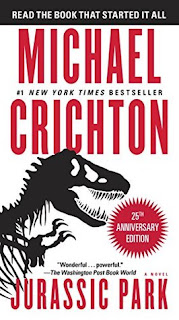
Jurassic Park


I've considered reading Michael Crichton's Jurassic Park on and off over the years.  I love the Jurassic Park movie.  I also really, really liked Crichton's book Timeline when I read it years ago (before this blog existed. I thought it was the only Crichton book I've read, but I also apparently read Next over a decade ago; I don't remember it at all).  But I never got around to it.  I think I had a paperback copy for awhile, then got rid of it.  But then a few months ago I was talking to a friend about it and ended up picking it up on my Kindle.  My friend really liked it, and recommended it as a must read for dinosaur lovers.  

The movie follows the overall plot of the book fairly well, so if you've seen it, you know what happens.  Dr. Grant, Dr. Sattler, and Ian Malcolm are all invited to John Hammond's island to tour his amusement park.  The lawyer, Donald Gennaro, wanted their help in assessing whether or not to close down the park.  Hammond also invited his grandchildren to the park in the hopes that their presence would help Gennaro see the wonders the park gave to children.  

The characters are a bit different from the movie though.  Lex is only 7 or 8 and a tomboy (and a very stereotypical annoying kid).  Tim is older and into computers as well as dinosaurs.  There's a PR person who takes them around on the tour.  And Dr. Settler (who is much younger than I would have thought) seems to mostly be present as an audience for Ian Malcolm's lectures.

They're also....kind of flat.  And honestly not particularly interesting people (I think because they're flat). 

There's also a lot of science throughout the book.  In Timeline, I remember the science being front heavy - once you got through the first bit, the science was all explained and the story just happened.  In Jurassic Park, the science is throughout the book, often halting the story to be explained.  And it's not just one kind of science: you've got genetics, paleontology, biology, chaos theory mathematics, computer science (the book hasn't aged particularly well in regards to the technology - it was written at a time when CD players needed to be explained in detail).  

Also: misogyny.  Everyone is so surprised that Dr. Sattler is a woman.  But then she gets to just do stereotypical woman things (go help take care of Dr. Malcolm while us men figure everything out), forgetting that she's just as smart as the men in the room.  It really bothered me knowing how great and active she was in the movie (a lot of the things she does in the movie are done by Gennaro in the book).

So all in all, I found Jurassic Park to be quite the let down.  But now I want to go and rewatch the movie, which I think is far better paced than the book was!

Friday, January 7, 2022

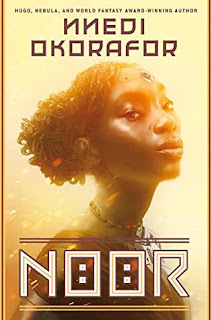
Noor


For my first book of 2022, I decided to read Noor by Nnedi Okorafor, one of the library books I have out.  I really enjoyed the worldbuilding in her Binti series, so I was looking forward to more of the same.

Noor follows Anwuli Okwudili (or AO as she prefers to be called), a young woman who was born wrong (and later in a freak accident which made everything worse).  Against the wishes of her family and the larger society, she's had many cybernetic upgrades, which allowed her to walk.  But the larger society of Nigeria looks at her as a freak and devil as a result.  So one day when she goes to a market, one which she always thought was quite safe, where the people knew her, a group of men attacked her.  She fights back, and kills them.  Fleeing for her life, she makes her way north towards the desert and the Red Eye, a disastrous sandstorm that has cropped up on Earth that is similar to Jupiter's Great Red Spot.  Taking herself offline, she fully intends to just go and die.  But she encounters a Fulani herdsman named DNA and his two remaining cows (GPS and Carpe Diem) who have also just escaped from their own tragedy.  And so they end up on the run together.

While the book is short (I think it's only 211 pages), I felt like it trudged forward, even during what should have been the faster paced action scenes. Which was odd, because then suddenly the book just seemed to end abruptly.  I will admit though, I did really enjoy the end, despite it feeling so hasty.

I also felt like it didn't spend enough time with the characters of the book.  I had a pretty good feel for AO, but I felt like I was being told about her, rather than being allowed to connect with her on an emotional level. That was true of the other characters too (although as you moved away from AO, I felt like you had less and less of a feel for anyone, including DNA).  

All in all, I found Noor to have some interesting ideas, particularly about identity and fitting in, but it just never came together as a whole for me. :(

Tuesday, June 15, 2021

Engines of Oblivion


I've been excited to read Engines of Oblivion since finishing Architects of Memory a few months ago.  I've had it for a few months on my Kindle, but got caught up in the Divine Dungeon series, so put off reading this until there was a good spot to pause that series.  

Engines of Oblivion follows Natalie Chan, one of the crew members from Twenty Five.  In Architects of Memory, Natalie, a soldier by training, had managed to become a citizen of Aurora, but lost many of her memories during the battle of Tribulation.  It's a year later and she's now the Director of Aurora's research and development team.  When the board sends her janitor indentures to pilot a new rig she designed, Natalie makes the split-second decision to pilot the rig instead because it is going into an actual combat mission (and the janitor indentures are not at all combat trained).  To her horror, Natalie discovers too late that the weapon within the rig was switched out for something far more deadly.

Called to a Board meeting after the demonstration, Natalie's loyalty to Aurora is called into question.  She is informed that she will be going on a mission back to Tribulation to locate Ashlan Jackson, whose heartbeat was detected.  Accompanying her is the one woman Natalie wants nothing to do with: Reva Sharva, the doctor who was the head of the Sacrament Society, and who had been experimenting on people in a secret lab on Tribulation; Sharva is being sent because she is the only one who can save Ash from the sickness she has (and Sharva has a bomb in her head that will detonate if she deviates from the mission).

This mission calls everything Natalie believes in into question.  Will she give up her friends to the company in order to keep her citizenship, even though she knows nothing good can come of turning them in?

I will admit, I didn't really like Engines of Oblivion at first, and that was largely because I didn't really like Natalie Chan.  And her being paired up with Reva Sharman definitely didn't help.  I also found the story a bit weird once the Vai got more involved.  On the one hand, it made sense for how the story went once they were involved (and I did like learning a bit more about them and how they worked).  But at times it got really hard to follow (especially once people were basically fighting inside each others' memories and minds, that got a bit hard to follow).  But by the end, I found that I really did care what happened to everyone, and, while in some ways sad, I really enjoyed the ending.

So while, in the end I did enjoy the book, I think I liked Architects of Memory better.  I missed the quirky crew dynamic of Twenty Five.  I also think this book might be better if read closer to the first book - while I remembered people and plot well enough as the book unfolded, it definitely would have been helpful if that first book was more fresh in my mind.

Sunday, June 13, 2021

Fugitive Telemetry


 I've been waiting to get my hands on the newest book in Martha Wells' Murderbot Diaries series, Fugitive Telemetry.  As I said after reading book 5, Network Effect, I was quite interested to see where the series would go now.

Well, Fugitive Telemetry didn't pay off with any of the stuff Network Effect set up.  Instead, it opens on Preservation Station, where a body has been found.  The Station's Security team (reluctantly) brings Murderbot in to consult as they try to find the murderer.  As murder is extremely rare on Preservation Station, they shut the entire port down to investigate the murder.  

What follows is a really fun mystery while Murderbot tries to find the murderer (and both Murderbot and Station Security struggle to trust one another). 

So while Fugitive Telemetry did not have the further adventures of Murderbot and ARK, like I though it would, or feature the newly free SecUnit, Three, it was still a really fun read.  Like most of the other books, I couldn't put it down.  I hope the next (as yet unnamed) Murderbot book is fun like this one was!

Friday, March 5, 2021

Starcraft: Survivors


 The reason I (re)read Starcraft earlier today was I mistakenly thought it was volume 1 to a newer graphic novel that I saw at the library, Starcraft Survivors.  But no, these two are totally different storylines!

Unfortunately the library doesn't have volumes 1 and 2 in this series, so I had to just jump into volume 3 and hope I could figure it out.

Starcraft: Survivors starts directly after a Dark Templar woman has killed all but one member of a Terran ship.  She spares Caleb's life as long as he is useful in her search for great power.  One of his crewmates' thoughts provides a clue: an Umojan Lab; this leads the two of them to a planet under the Umojan Protectorate.  Caleb is sent to fit in with the locals and find this power.  But he's hindered by the impatience of the unnamed Dark Templar. She kills someone as a warning to Caleb to hurry up, and threatens to kill more within five days if he cannot find the lab.

While it took a bit to get into the story (again, volume 3 in the series), Starcraft Survivors was really good.  The ticking clock from the murderous Dark Templar set the stakes high as Caleb is trying to blend in and keep his head down, all while the other workers in his factory try to befriend him (and he gets drawn into their friendship despite attempts not to).  Gabriel Guzman's art is the perfect compliment to Houser's text.  And just look at that cover image by Guzman - it's creepy, and perfectly encompasses the story!

I really liked the characters (and would love to know more, especially about the mysterious Dark Templar woman - what was she trying to do?  Why did she need great power, and who was she trying to get revenge against? Unfortunately this story didn't shed light on it (I was hoping for some sort of afterword, but no such luck!)

I did spend a bit of time Googling Dark Templar though, because part way through this story I noticed the unnamed Dark Templar's face - and it looked like she had a hydralisk-style jaw!  That did not seem right to me, and I originally figured she might be some weird kind of Protoss-Zerg hybrid (which might also explain her wanting revenge...), but a Google search turned up other images of some Dark Templar with that style jaw bone.  So that's neat, I had no idea that was a thing! 

I also want to note, I love that they're doing these kinds of stories with Starcraft now!  None of these characters are part of the games, or interact with major characters from the games, which I liked because this story helps to expand the world of Starcraft, showing that it really is a universe with all kinds of people in it.  I hope they continue making these kinds of stories - while I do love many of the main characters, it's nice to see new ones added, too. :)

Starcraft (Reread)


Lol!!!  So apparently I read Simon Furman's Starcraft graphic novel years ago, but didn't remember it at all!  The only reason I discovered it was a reread is because I marked it off on Goodreads!

This story follows a band of mercenaries who were sent to do the Terran Dominion's dirty work.  They're betrayed and scatter.  But two years later, they're given the chance to clear their names if they do one more job: kill the mercenary leader Jim Raynor.

The beginning of the comic is really hard to follow, especially when you're trying to figure out who all the characters are (I got hung up for a long time on trying to figure out if someone was left for dead but survived and came back, or if it was another character coming after them). I also had no real connection to any of the characters and didn't really care what was happening.  But by about halfway through, I started to put the pieces together a bit better and found myself caring about what happened to them.

Of course, the story was greatly boosted by Jim Raynor appearing.  He's such a great character and really added the touch that was missing, particularly for Cole Hickson's backstory (that they knew each other from before, and that Hickson helped Raynor get through an ordeal at a POW camp they were both in).

Unfortunately the series was cancelled before the second arc was finished, so I don't get to read more about these characters. :(

Thursday, January 28, 2021

Architects of Memory


I've been waiting to read Karen Osborne's Architects of Memory, the first book in the Memory War duology, for quite some time now.  I was excited to finally get my hands on it.  I started it over the weekend and would have finished it sooner but I had to put it aside for a few days while I was doing some training for work.  Once that was finished though, I immediately picked it back up and finished it. :)

Architects of Memory follows Ashlan Jackson, a salvage pilot who is terminally ill.  She lives in a world where you sell yourself to a company in order to eventually earn citizenship with that company; unfortunately some are much worse than others, charging you for every little thing (and extending indefinitely the terms of your indenture).  For someone with a terminal illness, it's much worse because if the company finds out about it, they can cancel your contract and leave you to die.  So Ash does everything in her power to hide her illness to buy her time to finish her contract and hopefully pay for treatments.

Her salvage crew is sent to clean up the wreckage of another ship from an inter-company war; while going through her routine salvage operations, Ash discovers that there was an alien weapon on board, one powerful enough to destabilize the tenuous peace among the companies.  And for some reason, she is able to handle it...

Overall I really enjoyed Architects of Memory.  Michael R. Underwood's endorsement on the back of the book said it was for fans of Firefly and I really got that.  This was a quirky crew that overall I really enjoyed hanging out with (although I admit I would have liked to have read a bit more of them just hanging out doing their things; they get separated from each other pretty quickly). 

The world of Architects of Memory was interesting, and unfortunately could very much become reality if corporations control the means of getting into space, I could see people basically going into slavery to them to get themselves into space as well. While Ash's crew didn't seem to have hard boundaries between the indentures and citizens, it was really interesting to see how that played out on some of the other ships.  I should also mention that I liked Osborne's aliens, the Vai, as well (although I admit to some confusion on how they could have come to be...)

I do think my biggest complaint was the ending though.  It didn't really feel satisfying; I honestly thought Ash would make more of an attempt to get out to the White Line, possibly dying in the process (I also admit to not really understanding what the White Line was exactly, beyond being the border the Vai retreated to).  But as I said, overall I did enjoy the book; it's a fast paced read and I would definitely like to read the second part when I get the chance! :)

Sunday, August 9, 2020

Network Effect


I completely forgot that Network Effect, the fifth Murderbot Diaries book by Martha Wells, was coming out this spring.  I also forgot that I put it on hold at the library.  So I was pleasantly surprised to get it last week! :)

I wasn't sure where this book would be taking Murderbot.  I thought the story ended quite nicely in book 4.  It starts out with Murderbot being contracted out to provide security for some of Dr. Mensah's family on a voyage.  Everything is going fine until their ship returns to Preservation space and is attacked by what looks like ART (from book 2).  While trying to protect Amena (a teenager from Mensah's family - I'm not 100% sure of what their relationship is as Amena keeps calling Mensah "second mother"), Murderbot and Amena are forced to flee the ship and end up on ART.  Unfortunately, ART is gone and there are strange grey people (possible aliens, or humans who have been modified by an alien remnant) on board.  After admitting to deleting ART, they get more than they bargained for with Murderbot destroying them (they mistakenly thought Murderbot was a human). 

Network Effect took a lot of crazy twists and turns.  Some of the other humans from the Preservation mission got trapped along with them (their ship got pulled into the wormhole that the aliens took ART's ship through). ART hid a backup of himself for Murderbot to find.  Looking for ART's crew leads everyone to the planet where the grey people are from, which was a lost colony with quite a history.  Half of ART's crew were sent down to the planet, while the other half remained on a shuttle as hostages.  ART and Murderbot decide to make Killware as a last resort, which ART ends up deploying onto the shuttle.  The Killware is a copy of Murderbot's personality, and ends up calling itself Murderbot 2.0.  Meanwhile Murderbot 1.0 went down to the planet to save ART's crew but ends up getting captured itself, which leads to a battle against the enemy targetControlSystem.  Luckily Murderbot 2.0 found its way to Murderbot 1.0 to help.

Despite all the fun stuff happening, I had a really hard time reading this book.  The middle, when everyone was trying to figure out what was going on and where the missing crew was, really dragged (as did Murderbot and ART's feud).  Unfortunately it took me a lot longer to read this book as a result (all the other Murderbot books I couldn't put down; this one I had a hard time picking back up).  That being said, it was an interesting story, and I am looking forward to Murderbot #6 (ART asked Murderbot to join it on its next adventure, and Murderbot decided it wanted to, as long as it can come back to Preservation to visit Mensah.  This was the first time Murderbot knew what it wanted).

Also I forgot to mention, Murderbot 2.0 helped another SecUnit hack its governor module on the shuttle to help rescue ART's crew there.  This new SecUnit, which called itself Three, wants to help Murderbot too.  So I'm quite interested to see what happens with a second rogue SecUnit!

Monday, May 11, 2020

Grail

Well, here we are: Grail!  After Chill, I really wasn't sure what to expect, beyond the fact that the Jacob's Ladder was going to choose a destination.

Grail takes place fifty years after Chill.  The Jacob's Ladder has been slowly travelling towards the planet they've termed Grail.  During that time, the inhabitants have established a sort of peace.  Wars and uprisings have been quelled under First Mate Tristen.  The world has been repaired as best it can.  And both Captain Perceval and Nova have made peace with each other and their roles. 

But when the Jacob's Ladder finally enters Grail's system, they discover that others have made it there, first.  It seems that humans survived on Earth after the Jacob's Ladder left a millennia ago.  These other humans have evolved their own cultures and technologies, including altering their brains, making themselves more cooperative and less competitive.  And these other humans aren't keen on sharing Fortune (their name for Grail) with warlike outsiders.

I really liked the ideas brought forth in Grail about the diverging human cultures and technologies.  When the Jacob's Ladder entered Fortune's star system, their broadcasts used old technology according to the humans already on Fortune (they had to dig up hobbyists to help them understand it).  Likewise, the people of the Jacob's Ladder spoke an outmoded language....it would be like if the people who spoke Old English diverged into two groups, and found each other now; both groups would be speaking different languages that devolved from the same source (this analogy isn't exact though, because the Jacob's Ladder humans were speaking a language that was more similar to 21st century English than the ones on Fortune, so scholars of 21st century English were still able to communicate with them). 

But culturally, both groups had diverged so much; the humans of Fortune outlawed genetic modification, while those from Jacob's Ladder needed it to survive in space.  I actually liked how the humans of Fortune looked down on those from the Jacob's Ladder as barbarians, that their way was better (even though the people of the Jacob's Ladder were able to see how they weren't really so different, that what the people of Fortune had done to themselves was actually very similar to what those of the Jacob's Ladder had done to survive).  And maybe the people of Fortune haven't actually changed as much as they believe, for there is an assassination attempt against Perceval when her and Tristen are invited down to the planet to help them decide whether or not they want to submit to the necessary surgery if they are to be accepted by the colonists.  (While I wasn't planning on going into it here, Cheryl Morgan talks about the diversity within the whole series, specifically in relation to Grail and how the people of Fortune have eliminated diversity from their population.  Check it out, it's worth the read!)

Unfortunately, the fun cultural clash wasn't the only thing going on in Grail.  A murder and theft alert the crew of the Jacob's Ladder to the presence of remnants of beings they thought long vanquished (specifically Ariane Conn and Dust).  So large chunks of the book are devoted to trying to find and stop the duo.  This part of the book felt like a rehash of the earlier ones; sure, the ship is now functional, so there's no multi day adventure to the bowels of the ship.  But seeing how they were both defeated in the first book, their specters reappearing (and as much diminished versions of themselves) wasn't exactly exciting (like I said, it was a rehash).  I think a much more effective plot would have involved the Go-Backs, who, now that the ship is approaching an alien world, are trying to do everything to stop the ship from succeeding in reaching it (I used that specific example because Dorcas, the Go-Back priestess in Tristen's daughter's body, basically tries to stop the ship from infecting the planet at the end, but only because the means to do so were handed to her by Ariane, not through any agency of her own).

I should also mention that this subplot was pretty obvious.  I figured out pretty early on who Ariane was probably hidden in (Oliver Conn's body).  And failing that, my actual second guess (Chelsea Conn, because she had no character, lol) ended up being Ariane's backup plan (and the body she used to enact her ship takeover plan).

The ending of the book was also super weird.  To stop Dorcas from killing every living being on the ship (in order to save the alien planet from being infected by them), Perceval gets her to transform pretty much everything into an Angel (so much like Rien transformed herself at the end of Dust).  But then Perceval might remain in her body (but I'm not sure?  She was walking on a beach), and Nova decides to leave, but Rien wants to stay, so she does and is solid?  Honestly, I'm really not sure what the heck happened here.  But I do know that some of the colonists (specifically Amanda and Danilaw, the pair who went out to the Jacob's Ladder to meet everyone) decide they want to travel the stars as Angels too.  And some of the remaining crew (specifically Tristen and Mallory) go off together, too.

It was interesting to see how the characters had changed this time around.  With fifty years passing, Perceval has grown into a strong Captain.  Tristen is feeling the effects of his age more (he is weary of war, but will fight for his Captain when she needs him).  Danilaw and Amanda were interesting too; I wasn't sure how I felt about Danilaw at first, but it was good to have a character from Fortune who was somewhat more open-minded (although he was still a product of his culture and heritage, for he was the one who thought of those from the Jacob's Ladder as barbarians).  But he was interested in their culture, and was interested in trying to understand them (even though they terrified him because they were basically the monsters his ancestors got rid of through their "rightminding" surgery). 

So now here we are: the end of the Jacob's Ladder trilogy.  I'm not entirely sure how I felt about Grail....I enjoyed it more than Chill (I wasn't bored by the halfway point), but I also didn't enjoy it nearly as much as Dust (either time I read it).  I'm glad that the people of the Jacob's Ladder didn't submit to the rightminding, because that wouldn't have been a satisfying conclusion, but the end just felt weirdly forced (maybe because it kind of just happened so quickly and was weirdly vague?  It was a good peaceful solution in its way because the Jacob's Ladder won't need to take resources from Fortune or anything else in its system, nor will it infect the planet).  And I wish there had been more of the cultural stuff and less of Ariane and Dust.

But I'm glad to have finally read Grail, finishing the series once and for all.  And I'm glad that I liked Grail more than Chill!  I just wish the series had lived up to Dust.

Saturday, May 9, 2020

Reread: Chill

I still wish they'd used the other cover.
Like Dust before it, I remember only two things about Chill: the ending (albeit only vaguely), and how I felt about the book (specifically, in Chill's case, that I disliked it).  I wasn't looking forward to rereading it because of that dislike, but I was also willing to give the second book another chance.  Maybe it won't be so bad when I read it directly after the first book?

I already gave the synopsis of the book last time:
Chill picks up pretty much where Dust left off. Perceval is now captain of the ship, which she has managed to save from the dying nova star. The Jacob's Ladder is now accelerating, but it has been damaged in the process and is now in dire need of repair. So enters Caitlin, the Chief Engineer, who must find a way to repair the damage with the limited resources available onboard.

At the same time, Arianrhod, a woman who should have died, has escaped. And so Tristen, Perceval's First Mate and head of the house of Conn, and Benedick, Perceval's father and Tristen's younger brother, are trying to track her down. With a colourful cast of characters, many of whom appeared in Dust (like the necromancer Mallory and the basilisk/torch Gavin), the two brothers journey across the ship in pursuit. Engaged in a pincer movement in an attempt to cut her off, the two brothers encounter vastly different things, from carnivourous plant people to ancient enemies of Tristen's. 
In the beginning, I kept thinking that Chill wasn't as bad as I remembered it.  This time around, I was prepared for Perceval to basically be sidelined, so that realization wasn't a problem like the last time I read the book.  I also liked Benedick and Tristen.  While neither of them were as well developed as Perceval or Rien in Dust, I was willing to give them a shot.  But they never really end up well developed, despite some of their trials (this was particularly weird with Tristen; he's made to remember and atone for his past; while he endures, I never really got a sense of his anguish over the past, other than being told over and over again that he was hurting).  Benedick is joined by his younger sister, Chelsea, who I likewise never get a feel for; she's just someone kind of shoved along for the ride.
And as the narrative continued, more and more characters got added as point of view characters (compared to just the three of Perceval, Rien, and Dust in Dust).  And more and more of those point of views seemed unnecessary.  For example, the book would flash periodically to Arianrhod, who might tell the angel fragment of Asrafil (who was with her) that she had laid a trap for either Benedick or Tristen.  Then the book would cut to one of the brothers dealing with said trap.  Couldn't we have cut out the middle bit, and just gone straight to the brothers dealing with the traps?

Other than the aforementioned repetition of characters saying plans then other characters stumbling into said plans, the book is super repetitive in other ways.  I know that Perceval, Caitlin, Tristen, and Benedick are all still mourning over Rien's sacrifice.  But t felt a bit much that by halfway through the book everyone was still upset when dealing with the new angel, Nova (now don't get me wrong, it made sense for Perceval to still be struggling). 
And then, there was the plot itself.  Benedick and Tristen are trying to catch Arianrhod, but rather than meet up, they try to catch her in a pincer move.  They go through all kinds of holds and see all kinds of fantastical things.  And by about two thirds of the way through the book, it gets very, very boring.  They go from hold to hold, but nothing they encounter feels like it actually matters.  Will the plant people have any part in the story within Grail?  What about the Edenites (despite Tristen's parting words to their priestess that he'll be in touch after the crisis is over)?  They feel like these are just random diversions thrown at the characters that they have to deal with, rather than actual alliances that have more consequence.  The stakes don't even seem high, despite the fact that there's a giant alien asteroid thing attacking the ship that their dead sister captured.  I had to push myself to finish reading the last thirty pages or so, because I just didn't care about what was happening.  :(

But I did it: I reread Chill. And my quest to Grail is complete: I can now finally read the final book of the Jacob's Ladder series.