Pages

Showing posts with label Kindle. Show all posts

Monday, March 3, 2025

Flames of the Dark Crystal


Wow, I really did fly through The Dark Crystal: the Age of Resistance series!  I had to buy Flames of the Dark Crystal, the final book, on my Kindle because I couldn't wait to read it!

Flames of the Dark Crystal once again returns to Naia's point of view. Three of the seven flames of resistance have already been lit; now Naia and company just need to light the Stonewood, Grottan, Drenchen, and Spriton flames. After escaping SkekSa's ship, the Gelfling decide to split up, with Tavra (still controlling Tae's body because the Sifan was quite badly hurt in the fight against SkekSa at the end of Tides of the Dark Crystal) and Onica agreeing to go light the Stonewood and Grottan flames, while Naia, Gurjin,  Kylan, and Amri going south to light the Spriton and Drenchen flames. (Amri was given the choice of whether to go with Tavra and Onica to light his home flame, but chose instead to continue with Naia). Returning to Sami Thicket, Naia and company discover that the Spriton and Drenchen are on the verge of war between their clans, as the Drenchen want to march on the Skeksis at the castle but the Spriton under their maudra want to remain loyal to the Skeksis in an attempt to save their clan from the Skeksis' wrath. 

Naia also knows that getting the Spriton maudra to agree to light the flames of resistance will be tough. Maudra Mera made it clear from the original book that she was doing only what she thought was best for her clan. Even with Kylan's help, the group knows changing her mind won't be easy. Plus Naia's mother is pretty strong-willed, ready to go up against the Skeksis with only her clan. So getting her to back down and find another way won't be easy either. 

Knowing that the Mystics are linked to the Skeksis also makes Naia question whether violence is the answer, as killing a Skeksis means an innocent urRu will perish as well.

But in the middle of everything, Naia and company receive news that the Stonewood clan has been shattered by the Skeksis. Their maudra, Fara, tried to lead the clan against the Skeksis and was horribly beaten, and their home, Stone-in-the-Wood, was destroyed. 

After successfully stopping a war between the clans, losing her mother in a fight against SkekSa in the Swamp of Sog (though they succeeded in trapping skekSa rather than killing her), and lighting their two fires (plus knowing that the Grottan fire was also lit), the Drenchen and Spritons set out for Stone-in-the-Wood to help the remaining ragtag Stonewood Gelfling light the final fire. Unfortunately when they succeed in lighting it, they discover the Skeksis emperor, skekSo, can also speak through the crystal to the Gelfling rebellion. When the Gelfling do not give in to his demand that they stop this rebellion, he takes his Skeksis to forcibly crush the Gelfling in Stone-in-the-Wood. What follows is the epic battle for the spirit of the Gelfling rebellion!

As you can probably tell from my synopsis, like Tides of the Dark Crystal, a lot happens in Flames of the Dark Crystal.  The book is very fast-paced, which at times was detrimental because it made the story feel rushed. It was okay for the ending, but before that, everything felt a lot like Tides of the Dark Crystal: convenient and rushed. Like right off the bat, when Gurjin is magically there with Naia on skekSa's ship to rescue everyone else who was captive. He gave an explanation for being there, but it didn't really make sense. How was he even on the ship? I honestly thought he was going to be evil or something, but nope, he honestly just was there and tagged along with the group for the rest of the book.

I was also sad that we were back with Naia. I know it made sense with the narrative to be back under her pov, but she bothered me a lot, especially after being with Kylan and Amri during the last few books. I think I was really worried about how much she was doubting everything after the rescue of the group from skekSa - she felt alone, like people were moving away from her, and even like her brother had taken her healing powers. After everything she had gone through with these people to this point, those fears seemed silly. It made way more sense to be worried about the impossible task Thra and Aughra had given her, rather than the bonds she had with her friends.

I did like how things were handled when her mother died though. Having lost a parent myself, I both empathized with Naia and thought that sequence was well done. That was really brave of her to be able to put aside her grief and lead the Drenchen to Stone-in-the-Wood just after her mother died as well.

I also was glad that Naia and Amri got closer in this book. When I first started reading the series, I thought her and Kylan would end up a couple, but as the story unfolded, it seemed more likely that it would be Amri she ended up with, and I was glad.

The Garthim never do make an appearance in this series, which honestly was probably for the best. The series is about the Gelfling ultimately uniting to resist the Skeksis and take back their world; had the Garthim entered the narrative, even at the end, it would have drastically changed things.

So overall, I enjoyed reading The Dark Crystal: Age of Resistance book series. I'm glad to have read it, and I am looking forward to watching the show!

Friday, February 2, 2024

Measure What Matters: How Google, Bono, and the Gates Foundation Rock the World with OKRs


I don't remember exactly where I came across OKRs (Objectives and Key Results) as a method of goal setting. But I was intrigued and bought John Doerr's book Measure What Matters: How Google, Bono, and the Gates Foundation Rock the World with OKRs. I had previously encountered SMART goals (specific, measurable, achievable, relevant, and time-bound), but OKRs sounded like a better way to set goals. Having tried and failed with SMART goals a number of times over the years, I thought OKRs might be a better fit.

Doerr was a big fan of Andy Grove, the former CEO of Intel who first introduced Doerr to OKRs. So Doerr wrote this book in an attempt to better spread the OKR mantra. In Measure What Matters, Doerr give a history of Grove's methods and how they related to Doerr's life, then goes on to explain the method with a series of case studies from successful businesses that use the model.

At the beginning of the book, I was quite on board with things. The book was well written, the case studies were interesting, and I was excited to make OKRs work for me. Unfortunately, the more I kept reading, the more my enthusiasm for the book waned. I started to feel like I wasn't really getting to understand the method in a more in-depth way, which I would expect from the book. The case studies also weren't really helpful - the more the book went on, the more it felt like everyone was saying "we succeeded because of OKRs," without really going into nitty-gritty details. I actually felt like the most useful part of the book was the appendix with Google's OKR playbook (published with their permission), which actually walks you through how to set good objectives and key results, as well as pitfalls to watch for. Prior to that, a good chunk of the book started to feel like fluff and filler, which wasn't great; it made me want to stop reading.

I also went into reading Measure What Matters hoping for help with personal goal setting. But Measure What Matters is very much written for companies and their leadership, not for an individual trying to improve themself. So that was very disappointing as well.

While I am glad to have encountered the idea of OKRs, I didn't feel like Measure What Matters was a very effective book for learning about them. I also feel like other books will be more helpful for individuals wanting to set effective goals for themselves than this one is.

Sunday, June 25, 2023

Street Freaks


I was really looking forward to reading Street Freaks by Terry Brooks.  I've enjoyed many of his fantasy books, and was really interested in seeing what he could do in a science fiction setting.  

Street Freaks opens with Ash Collin's life imploding: his father sends him a message to get out of their house moments before bots storm the place.  Ash manages to escape and make his way to Street Freaks, the place his father told him to go should anything happen.  There he meets several kids who have all been "tweaked" in some way: Holly is a powerful cyborg who was reconstructed after an accident, TJ was born in a test tube and engineered to be the perfect soldier, Jenny has tanks that filter her blood, Woodrow, a boy whose entire body is robotic after a wasting disease almost killed him, and Cay, a synthetic girl created as a pleasure robot.  The group quickly takes him in, shielding him as best they can from the powerful group trying to find him, all the while helping him try to get to the bottom of why they are after him.

I wanted to like Street Freaks.  I really did. But I really, really didn't.

Most of the plot progressed through people simply refusing to tell Ash things right now.  The first time that happened, okay, whatever.  But by about the fifth time it happened, I'd really had enough of it.  It's one thing if the group put things together as they discovered them through hacking or whatever.  But people repeatedly just not wanting to tell Ash things got real old real quick.

Ash was also not the most interesting character.  He was naive and often very childish.  People repeatedly told him to grow up, and some of the things he failed to realize seemed really silly, especially after the book kept telling us he has an amazing memory - like how did he fail to put some of these things together?  He wasn't exactly unlikable (most of the time - I'll get back to that).  He was just super bland and uninteresting.  

The plot had some issues as well.  I knew (or at least very heavily suspected) fairly early on who was probably the bad guy.  And they were the bad guy.  But not in a super interesting way either.  More in the "I'm going to monologue for ten pages and explain everything" kind of way.  Which really shouldn't have been that surprising, as most of the book felt like explanation rather than action.  I was willing to forgive this at the beginning, as it takes place in a new world and everything was explained (though this felt a bit too on the nose - I would have preferred that we see how more things work, rather than being told about them).  But I was thoroughly sick of it as the book went on and continued in this vein.

There was also an unnecessary romance plot-line as well involving Ash and Cay.  Ash fell in love with her at first sight.  He was told (by some of the others, but even Cay herself) that she was built to be attractive to men (and women who are attracted to women), so he should get over this because it's not real and she's not interested anyway.  But he continues to try to pursue her, even after she repeatedly tells him to stop.  It was very cringe-worthy to be reading this over and over again.  But even more cringe-worthy when it eventually kind of works (at the end of the book she realizes that he actually does see her as a person, so she immediately loves him too).  

So unfortunately, I do not recommend this book.  I kept hoping it would get better, especially after the initial heavy-handed worldbuilding was out of the way.  But sadly, that was not to be.

Wednesday, June 15, 2022

Misrule

It took me a bit, but I finally finished Misrule, book 2 in the Malice duology by Heather Walter. I started it right after finishing Malice, got through only the prologue, then kind of just stopped when it said that 100 years had passed. But I made a point of getting back to it once I was in more of a reading frame of mind (I've really struggled to read so far this year) - I wanted to know how Alyce's story ended!


100 years after the fall of Briar, Alyce (now named Nimara, after the first Vila) has built the Dark Court over the ruins of Briar. All the creatures of Malterre are welcome here, and they have been waging war against the Fae, gradually taking more and more of the Fae courts. But unknown to most of the other denizens of the Dark Court, Princess Aurora slumbers in a hidden wing of the palace. Nimara has spent much of the last century scouring every old book she can find for some hint on how to break this second curse. But when a mortal man washes up on their shore and unexpectedly wakes the sleeping princess, everything Nimara thought she knew is thrown into question.

While the story is in many ways similar between the two books, I overall found Misrule to be a very different book from Malice. There were so many different characters of different races, that I really struggled to keep everyone straight, particularly those of the Dark Court (a list of characters really would have helped!) Nimara was also thrown in so many different directions thanks to the people around her (plus her own wants), that in many ways it felt like she hadn't grown at all in the last 100 years, at least right until the end of the book when she started to take charge of her life. Which I admit was a really weird feel for a character who had overseen the Dark Court for a century.

Some of the events that happened also kind of didn't make sense. Like why, of all the remaining Graces, would Nimara choose to use Rose of all people? Rose should have been the very last person she would have used given their history. 

But I will admit, the end did surprise me! I thought the plot was moving towards a certain outcome, but it ended up doing some stuff that I didn't expect at all, which was rather fun! In particular, the climax with the Faerie King didn't play out at all how I was expecting.

All in all, I did enjoy the Malice duology. I hope Walter will write more books set in this world - I would love to read about other characters and eras (like the first Vila, or how the rest of the world reacts to the events of Misrule).

Sunday, April 3, 2022

The Deep


 I've been wanting to read The Deep for awhile now, but finally sat down to read it a few nights ago.  It tells the story of a mermaid (Yetu) who, as the historian, holds all the memories of her people, of their trauma and how they came to be. While she is gifted, she is also extremely sensitive, and the memories are literally killing her. So when the time comes, as it does every year, to let her people remember, she decides to run and save herself, rather than take the memories back at the end of the ritual (and so die).  While she slowly regains herself and her sense of self away from the memories, she becomes increasingly aware that the memories are killing the rest of her people, and so needs to decide whether to live or to save them all.

I really enjoyed The Deep.  I loved the worldbuilding around where the merpeople came from (they are descended from pregnant African slaves who were thrown overboard - the idea is that in the womb, babies are not breathing air, so what if they were born of the sea and never needed to breathe air? A very interesting narrative that has roots in songs - this article talks a bit about it, as well as the idea that people would like a memorial along the Atlantic trade routes, which is definitely deserved considering how many people died along them)  And the idea of holding all the trauma from generations of your people (and it wasn't just the trauma, it was their actual memories) was really interesting - as historian, Yetu wasn't really living, she was living the lives and trauma of all the people who came before her.  

Definitely check it out if you have the chance (and are okay with reading fantasy)!

Saturday, January 29, 2022

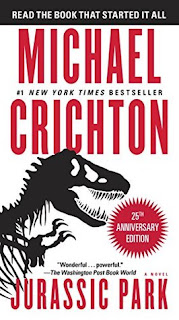
Jurassic Park


I've considered reading Michael Crichton's Jurassic Park on and off over the years.  I love the Jurassic Park movie.  I also really, really liked Crichton's book Timeline when I read it years ago (before this blog existed. I thought it was the only Crichton book I've read, but I also apparently read Next over a decade ago; I don't remember it at all).  But I never got around to it.  I think I had a paperback copy for awhile, then got rid of it.  But then a few months ago I was talking to a friend about it and ended up picking it up on my Kindle.  My friend really liked it, and recommended it as a must read for dinosaur lovers.  

The movie follows the overall plot of the book fairly well, so if you've seen it, you know what happens.  Dr. Grant, Dr. Sattler, and Ian Malcolm are all invited to John Hammond's island to tour his amusement park.  The lawyer, Donald Gennaro, wanted their help in assessing whether or not to close down the park.  Hammond also invited his grandchildren to the park in the hopes that their presence would help Gennaro see the wonders the park gave to children.  

The characters are a bit different from the movie though.  Lex is only 7 or 8 and a tomboy (and a very stereotypical annoying kid).  Tim is older and into computers as well as dinosaurs.  There's a PR person who takes them around on the tour.  And Dr. Settler (who is much younger than I would have thought) seems to mostly be present as an audience for Ian Malcolm's lectures.

They're also....kind of flat.  And honestly not particularly interesting people (I think because they're flat). 

There's also a lot of science throughout the book.  In Timeline, I remember the science being front heavy - once you got through the first bit, the science was all explained and the story just happened.  In Jurassic Park, the science is throughout the book, often halting the story to be explained.  And it's not just one kind of science: you've got genetics, paleontology, biology, chaos theory mathematics, computer science (the book hasn't aged particularly well in regards to the technology - it was written at a time when CD players needed to be explained in detail).  

Also: misogyny.  Everyone is so surprised that Dr. Sattler is a woman.  But then she gets to just do stereotypical woman things (go help take care of Dr. Malcolm while us men figure everything out), forgetting that she's just as smart as the men in the room.  It really bothered me knowing how great and active she was in the movie (a lot of the things she does in the movie are done by Gennaro in the book).

So all in all, I found Jurassic Park to be quite the let down.  But now I want to go and rewatch the movie, which I think is far better paced than the book was!

Tuesday, October 5, 2021

Unreconciled: Family, Truth and Indigenous Resistance


For September 30th, the very first National Day of Truth and Reconciliation here in Canada, I wanted to read a book that would further my understanding of Indigenous issues here in Canada in some way.  I wasn't sure exactly what I was looking for (and was open to books on everything from culture to residential schools), but while looking over books online I found Jesse Wente's Unreconciled: Family, Truth, and Indigenous Resistance.  It was brand new and already well rated, so I decided that it would be the book I read this year on this day.

I wasn't familiar with Jesse Wente prior to reading this book, which is both his memoir and manifesto, but he is an Indigenous journalist and film critic who has had a very successful career in Canadian media.  In Unreconciled, he talks very frankly about how the residential school system damaged his family, making him and other members of his family feel like outsiders when they visit their family who still live on-res at Serpent River First Nations.  

He also talks at length at how there are so few people of Indigenous descent working in the media.  How Indigenous stories are so often co-opted by white people, put through a white lens and profited off of.  And how people from minorities are often made to speak for their entire group, and how there is tremendous pressure to succeed if you break through into an area because you do not want the door to close for everyone else should you fail.  Or how people of minorities, himself included, can be reduced to tokenism, standing in for their entire group, or, far uglier, being co-opted by institutions and businesses as a kind of endorsement, even if you don't actually endorse what they're selling.

While at times difficult to read, I thoroughly enjoyed Unreconciled. Wente infuses the book with humour while still showing us how Canada as a country has failed, and encouraging us all to do better.  Unreconciled is definitely a book I recommend to all Canadians, for it speaks the truth, which goes hand in hand with reconciliation.

Tuesday, September 7, 2021

Dungeon Eternium


Well, here we are: the final book in Dakota Krout's Divine Dungeon series, Dungeon Eternium!  

Dungeon Eternium picks up pretty much right where Dungeon Desolation left off.  They've beaten Xenocide's powerful Runes that were drawing the moon to the planet, but unfortunately that damage has already been done.  While they have more time now, the moon is still going to crash into the planet.  Also, Cal's leylines are also destroying the planet because there will no longer be any free-floating essence, devastating the world even if it survives the moon.  The only option is to have as many people as possible hide in a large enough soul space, assuming the one being with a big enough one (ie Cal) agrees.  

I found Dungeon Eternium a bit dry at first.  Most of the Cal parts were just him by himself.  He was doing whatever on his own without Dani or one of the Bobs to throw ideas around with.  Dale was also just kind of doing stuff - he's no longer a noble, so he wasn't really part of the goings on politically anymore.

But I did find the stuff with the Northmen interesting, mainly from Cal's perspective.  He started exploring their city and found a dungeon underneath them.  The two dungeons made an exchange that Cal thought was well worth his while, and it was interesting to encounter another Dungeon that was so cunning. 

Dani's "brother" also turned up at one point.  He was a dungeon core that grew up with Dani, so they started calling each other brother and sister.  That was admittedly a weird little side bit to the story because he didn't really add anything to the plot (and his character wasn't overly interesting either - he was a core stuck in a backpack - he couldn't spread his influence anywhere, and Cal and Dani just kept shoving him in a chest whenever Grace was around to make sure she didn't bond to him).

But then Dungeon Eternium took a few interesting turns.  First, Cal went to the very North of the world as per Dani's request.  There he found the oldest Dungeon around (Dungeon Eternium), who created the Wisps.  While the Dungeon could have destroyed Cal with merely a thought, he asks for Cal's help because the moon is going to directly impact him (which was apparently Xenocide's plan all along?)  Eternium helps Cal with some stuff, and in exchange, Cal helps bring Eternium into his Soul Space.

What was really fun about this exchange was that Eternium didn't understand Cal's language.  Cal had to give it to him, and he immediately understood and used it perfectly because he is such an immense, ancient, and wise being.  It was a neat moment.

But then the fun really began.  Barry returned and took over Mountaindale once again (but this time from the Master, who was sick of the politics anyway and so didn't care).  He took all kinds of tribute, and started trying to control who would enter Cal's soul space (although when his back was turned, the Dark Elves all snuck in).  Once almost everyone was through, he summoned his new master: Xenocide (this scene had some hilarious dialogue between the two)!  Then he made his way through the dungeon, killing everything in his path with his weird and deadly power.  Cal orders everyone to escape, but Barry catches Cal and tries to eat him and all the souls now contained within his Soul Space.  But rather than die, Cal and Dale become rejoined.  But Dale's human body cannot contain the totality of the two of them (especially since Cal is so much more than a human, plus he's in the A ranks where Dale is B).  So they have to make their way back to where Barry is before their body fails to get the perfect replica Dungeon Core that Cal made (he was hoping to use it as a distraction, but Barry knew which one was really him).  

This whole part was so intense - I loved it!  It felt like a real culmination of Dale and Cal's arcs, and a really fun way to bring them together.

So while the beginning of this book was a bit dry, it's totally worth the read.  Everything (even stuff from Dungeon Desolation, my least favourite book in the series) comes together really well.  I really enjoyed both this book and the series as a whole.  :)

And now my friend who recommended this to me wants me to start reading  

Sunday, August 15, 2021

Dungeon Desolation


Rather than sleep, last night I stayed up super late reading Dakota Krout's Dungeon Desolation, the fourth book in the Divine Dungeon series. The Master's armies of undead are rampaging across the world, but Mountaindale, the town on Cal's floating island, remains relatively untouched.  At least until the Guild decrees that all human titles are forfeit and the town and academy are now in their hands to support the war effort.  They send an obnoxious S-level Mage to conscript Cal as well - he kills an entire floor (even Cal's essence within it), and threatens to kill the rest of the dungeon if Cal refuses to cooperate.  They want to use the dungeon to ferry troops to the back of the Master's armies.

Cal of course does not take this well, and immediately starts planning how to get out of this (and specifically how to kill the S-level mage, even though Cal himself is only a B-Level dungeon).

Dale is no longer Baron (although he remains a Duke with the Dark Elves), and so is in major danger of being conscripted into the army.  So he signs himself up at the academy as the protege of the headmaster whom he had just hired.  The clerk takes a disliking to Dale, and conspires to get him booted out of the academy by not issuing Dale receipts for his tithes to said academy (but luckily Dale gets wind of this and is able to remain in the dungeon long enough to more than make up for the shortfall).  Unfortunately, all his training, specifically to strengthen his aura, makes an imbalance within him, and Dale starts becoming uncharacteristically aggressive, both in the Dungeon and without.  It takes the intervention of his teachers to knock some sense into him (quite literally!)  

While I enjoyed reading Dungeon Desolation, I didn't think it was quite on par with the other few books.  For one thing, there was a lot less Dani than in earlier books (she was training their daughter, Grace).  For another, there was a lot less of Cal doing fun and crazy things - it was kind of more of the same from book 3 (he was mostly finishing up his ley lines, and dealing with flying).  He did make a few new monsters and floors, but nothing really fun (I guess other than his battle royale of elementals that he set up and let fight and evolve on their own).

The ending was rather unexpected though: everyone was manipulated by Xenocide, the super-ranked Mage of Madness (I have no idea what his level is, but it appears to be more powerful than anyone else, even the Master) for the last several hundred years so he could get everyone into a particular place at a particular time to power a ritual for him to attract one of the planet's moons to the planet, killing everyone and "freeing them of their madness."  Now everyone has to work together to stop him, if it's even possible.

While not the best in the series, Dungeon Desolation still had some fun moments.  It'll be interesting to see how the series ends in Dungeon Eternium.

Tuesday, June 15, 2021

Engines of Oblivion


I've been excited to read Engines of Oblivion since finishing Architects of Memory a few months ago.  I've had it for a few months on my Kindle, but got caught up in the Divine Dungeon series, so put off reading this until there was a good spot to pause that series.  

Engines of Oblivion follows Natalie Chan, one of the crew members from Twenty Five.  In Architects of Memory, Natalie, a soldier by training, had managed to become a citizen of Aurora, but lost many of her memories during the battle of Tribulation.  It's a year later and she's now the Director of Aurora's research and development team.  When the board sends her janitor indentures to pilot a new rig she designed, Natalie makes the split-second decision to pilot the rig instead because it is going into an actual combat mission (and the janitor indentures are not at all combat trained).  To her horror, Natalie discovers too late that the weapon within the rig was switched out for something far more deadly.

Called to a Board meeting after the demonstration, Natalie's loyalty to Aurora is called into question.  She is informed that she will be going on a mission back to Tribulation to locate Ashlan Jackson, whose heartbeat was detected.  Accompanying her is the one woman Natalie wants nothing to do with: Reva Sharva, the doctor who was the head of the Sacrament Society, and who had been experimenting on people in a secret lab on Tribulation; Sharva is being sent because she is the only one who can save Ash from the sickness she has (and Sharva has a bomb in her head that will detonate if she deviates from the mission).

This mission calls everything Natalie believes in into question.  Will she give up her friends to the company in order to keep her citizenship, even though she knows nothing good can come of turning them in?

I will admit, I didn't really like Engines of Oblivion at first, and that was largely because I didn't really like Natalie Chan.  And her being paired up with Reva Sharman definitely didn't help.  I also found the story a bit weird once the Vai got more involved.  On the one hand, it made sense for how the story went once they were involved (and I did like learning a bit more about them and how they worked).  But at times it got really hard to follow (especially once people were basically fighting inside each others' memories and minds, that got a bit hard to follow).  But by the end, I found that I really did care what happened to everyone, and, while in some ways sad, I really enjoyed the ending.

So while, in the end I did enjoy the book, I think I liked Architects of Memory better.  I missed the quirky crew dynamic of Twenty Five.  I also think this book might be better if read closer to the first book - while I remembered people and plot well enough as the book unfolded, it definitely would have been helpful if that first book was more fresh in my mind.

Monday, May 3, 2021

Dungeon Calamity


Book 3 of Dakota Krout's Divine Dungeon series sure took some crazy turns!  Dungeon Calamity opens with Cal being brought back to himself by a mysterious man who wants his "whispers" back.  The man was surprised that Cal even answered when he spoke to him, but with that settled, the mysterious man left the dungeon.  Cal's goblins, the Bobs (the Bobs are specifically clones of his original Goblin Shaman) are overjoyed that he's back - a month has passed and Cal went decidedly insane.  He was throwing crazy traps and mobs against adventurers and failing to clean anything up. Terrified that this reprieve from madness will be short lived, Cal starts making plans to go and find Dani.

To that end, Cal starts extending his influence downwards, looking for the molten centre of the planet.  He also gets the Bobs to help him start a new ritual which sets ley lines through the planet.  Finally, Cal fights his way into the Mage ranks, managing to tie himself to the most powerful concept in the process (the one that all the other ones originate from).

With Dale being his usual unhelpful self, and Cal losing contact with Minya, he embarks on his most daring adventure yet: controlled flight.  Using a gyroscope, he manages to get the mountain into the air and headed off to save Dani!

For his part, Dale was kind of doing more of the same.  Embroiled in the local politics, he manages to get a training school up and running in Mountaindale (that's the name of his new city).  The school is meant to be a place where people of all races and nations can gather to train, hopefully politics-free (although everyone is aware that they probably won't be able to keep all politics out).  He continues training with his Dark Elf teacher (and manages to piss his teacher off, so his teacher is now attacking him wherever and whenever).  But then when the nations of the world are attacked and decimated by a necromancer calling himself "The Master," Dale finds his and Cal's goals suddenly aligning.  

Dungeon Calamity was in many ways different from the other two books, mainly because Cal was without Dani (which was sad).  But it was full of really fund moments (and culminated in a crazy ending that I didn't see coming).  I'm looking forward to reading book 4! :)

Saturday, April 24, 2021

Dungeon Madness


I once again started reading another book that just sat for a few weeks of me not touching it.  Then on Friday, I finally admitted to myself that I wasn't really interested in reading that book right now because I wanted to read more of the Divine Dungeon.  So I started book two, Dungeon Madness, and finished it late last night (I should have stopped reading, but I was so near the end that I just powered through and finished).

Dungeon Madness picks up relatively where Dungeon Born ended: Dale can now hear Cal, the Dungeon, speaking in his mind.  But he's doing his best to ignore Cal.  Cal also discovers that Dale can't hear him when he leaves the dungeon, so Cal has to work around that.  

Outside of the dungeon, Dale's friend Hans cajoles him into taking a more active role in running the city that he's trying to develop around the dungeon.  Aided with knowledge from the memory crystals the dark elves gave him, he's becoming more politically astute.  Unfortunately some people don't take too kindly to this; they jump him and leave him to die in the dungeon.  Dale makes a desperate deal with Cal to remain alive.  In return he has to bring Cal things to eat so he can learn their patterns and make more.  Cal's first demand is for a bag of holding (although he decides Dale can bring that later when he decides he first wants the fluffy pink robe Dale was wearing instead).  

Meanwhile, villages around the mountain are mysteriously dying.  The people think it might be necromancers that are on the move, and so the nobles from the two nearby kingdoms are sending their children to the mountain to protect them.  Unfortunately it isn't necromancers that are causing the problems...the problems appear to be Dungeon Born and they want to come back home...

Dungeon Madness is a fun and quick read.  In a lot of ways it was similar to the first book, although with the added fun of Cal actively messing with Dale and company because Dale can now hear him.  (I did get a huge laugh when Krout was describing what everyone in Dale's group got, except for Hans, who got nothing because Cal doesn't like him).  But it does set up beautifully for book 3.  I can't wait to read more of the story soon!

Friday, March 19, 2021

Dungeon Born


 A friend of mine really wanted me to try Dakota Krout's Dungeon Born, the first book in the Divine Dungeon series.  It tells the tale of a soul that gets sucked into a soul gem and becomes a brand new dungeon.  The dungeon, names Cal by Dani, his wisp servant/friend, needs to grow and evolve, attracting adventurers to attempt the dungeon (and hopefully die along the way, feeding Cal energy and new toys to play with like weapons and runes).

Dungeon Born is also the tale of Dale, one of the sheepherders who discovered the dungeon (and the only one to live to tell the tale).  Dale ended up selling all his belongings to buy the entire mountain the new dungeon is on, knowing that all the people who will be interested in the dungeon will make him rich once word gets out.  This leads him into the Adventurers' Guild and training to become an adventurer.  It also leads him into politics as all the people who want to use the dungeon don't realize that he owns the entire mountain.

I'm not going to lie, the beginning of this gets a bit rough.  Krout's world is very much like an RPG system, complete with leveling of the characters, and for awhile Dani's explanations to Cal about everything really made me feel like I was reading an RPG rule set rather than a fictional story.  But once you get past that, the story gets super fun!  I'm quite excited to see where things go in Dungeon Madness, the second book in the series!

Thursday, December 26, 2019

Stress Less, Accomplish More

Whoops, I actually finished this book like a week ago but forgot to post about it here.  I came across Emily Fletcher's Stress Less, Accomplish More last summer thanks to Betty Rocker (I don't think this was the actual post where I first heard about it, but this gives the just of what I read).  Since the library didn't have a copy, I bought it on my Kindle.  I planned on reading it sooner, but didn't actually get to it until the flight home from my vacation earlier this month.  I read most of the book then, but didn't actually finish it until a few days later (I actually should have finished it a day before I did - I stopped reading that night because I thought there was still like 80% of the book to go, but that turned out to be mostly notes and the index!)

So Stress Less, Accomplish More explains Fletcher's method of meditation (or at least the lite version of her Ziva Method).  She grounds the book in science, showing how meditating just twice a day for 15 minutes can be so good for you, helping you finally beat stress and start accomplishing all that you want to in life.  Many celebrities and successful business people (many of whom share their stories in the book) have used the Ziva method (or other forms of meditation) to do just that.

Now I'm not going to lie: the book gets a bit repetitive.  It takes until chapter 8 before it finally tells you the Ziva method (the other like 7 chapters just keep going on about all the health benefits; while this was good to read, it definitely hit the point where she could have just listed the rest and gotten to the point, rather than going into so much detail).  That being said though, the book is easy to read, even while being so heavily grounded in science (neuroscience in particular). 

I was personally interested in reading Stress Less, Accomplish More because I had started meditating after reading You Have Four Minutes to Change Your Life, but have since fallen out of the habit.  I was hoping that reading this book would help me get back into the habit.  I was a bit daunted at the thought of trying to fit in two fifteen minute sessions of meditation per day (

Friday, December 20, 2019

Oddkins: A Fable for All Ages

Note: this review was originally written in a notebook on Dec 11/19 while I was on vacation last week.  I've made some minor edits to it while transcribing it.

"Oddkins: A Fable for All Ages" is another story I've had on my Kindle for quite some time.   A friend of mine recommended it to me (or at least I think he did - he may have recommended a different Dean Koontz and I got this one accidentally).  I've never actually read any Koontz before and wasn't really sure what to expect.  When I first started reading "Oddkins," I didn't know what to make of it, but once I got into it I liked it quite a bit.

After a magical toy maker passes away, it's up to his creations to find his replacement.  But the forces of evil want to claim the toy factory for themselves; a group of evil toys from the hidden sub-basement awaken and seek to stop the Oddkins, while an evil toy maker arrives to buy the factory.

The Oddkins were a fun group: they were all unique, yet very loyal and good.  I loved how they got through their various encounters (like how Butterscotch talked down the mongrel, or Patch stood up to the alley cats), and how each of them had dreams beyond their initial purpose of helping their special children.

The squad of bad toys were really well done too.  Rex and the others were all rather terrifying in their own ways, especially for the Oddkins (but I felt it too).  I also liked how besides being malevolent, their lack of empathy meant they didn't really work together because in a way they couldn't.  That was a really nice touch.

I have to admit, I'm now quite curious about what happens to Viktor, the adult who saw the toys and had his world unexpectedly awakened as a result.  What does he go on to do now?

My one major complaint was that I found the story a bit heavy-handed at times, particularly at the end.  But overall, I thought this was a well-written good vs evil showdown, which I do recommend.  Just not necessarily to all ages - it's a bit dark for children in my opinion.

The Mooncalfe

Note: this review was originally written in a notebook on Dec 10/19 while I was on vacation last week.  I've made some minor edits to it while transcribing it.

After finishing End Times in Dragon City,  I wasn't really sure what to read next.  But as I browsed through the 13 pages of things I have on my Kindle, I came across a David Farland story called "The Mooncalfe" and decided to go with that.

"The Mooncalfe" is a tale of King Arthur (or more accurately, Merlin).  A fey girl is conceived by the horned moon.  Her mother. who is ashamed of having been seduced, raises her daughter in secret, always warning her of what men will do when they see her (aka ravish her, particularly because she is beautiful)  After her mother dies, the girl seeks out a favour from the Lady, wanting to be made fully human.  Finding the Lady's fount, she encounters her father, Merlin, who seduced her mother because the portents seemed fair.  Upon discovering this, the daughter curses him, leaving him alone in his misery.

"The Mooncalfe" is a very well written little story.  I read it in no time and loved every minute. :)

Thursday, December 19, 2019

End Times in Dragon City

Note: this book review was originally written in a notebook on Dec 10/19 while I was on vacation last week.  I've made some minor edits to it while transcribing it.

Well, here we are: End Times in Dragon City - finished!

This book wasn't as good as Bad Times in Dragon City, although I still enjoyed it.  The problem is that the main character, Max, was stuck in prison for the first while.  And since the book is written from his perspective, nothing really happens until his friends break him out.

Let's back up a bit.  After Max killed the dragon at the end of Bad Times in Dragon City, Max was thrown into the highest level of the Garret so he could see the damage he had wrought to the City.  Freed from the dragon, the Ruler of the Dead immediately sent her armies to take out the city; her zombies are overwhelming the wall.  It's only a matter of time before she breaks through.

Eventually, Max's friends break him out of prison.  After catching him up on what's happening, Max decides they need to bolster the Imperial Guard and save the city.  But after the Guard blow up Goblintown, no one is interested in putting aside their differences in order to band together.  There's also one more problem: the dragon's corpse is decomposing in the middle of the city, a tempting target for the Ruler of the Dead.  If she gains control of it, Dragon City will be lost.

While I didn't think it was as good as the previous book, I still really enjoyed End Times in Dragon City, and thought it was a very fitting end for the trilogy.  I hope one day we'll get more of Max's adventures! 

I'd also love to know more about this setting!  How did the Ruler of the Dead first come into being?  If she's been stuck on this continent, what is the rest of the world like? And what happens next for Dragon City? 

Bad Times in Dragon City

Note: this book review was originally written in a notebook on Dec 9/19 while I was on vacation last week.  I've made some minor edits to it while transcribing it.

Wow. So I wasn't super sure how I felt overall about the first book in this series (although I did enjoy it).  But the second book was absolutely fantastic!

Bad Times in Dragon City takes place about two weeks after End Times in Dragon City.  Belle calls Max to her home to tell him that her sister's body has disappeared.  For most people this isn't a big deal, but for elves it's huge: an elf family has to produce the body within a few weeks or else a living elf must takes the deceased's place.  And because elves consider their elders treasures due to their knowledge and long histories, elf families typically send younger elves to stand in the deceased's place.  So that means Belle will go if Fiera's body isn't found soon!

I loved that detail within the worldbuilding.  And I loved how it was dealt with: Max assumed an elder would go because that's how humans deal with it - elders are near death, so let the young live.

Fiera's body disappeared the night after she died, and the family's manservant, Ford, was found killed around where it should have been.  So Max is determined to save Belle by finding it.  But all the while he's being called across the city to meet with powerful dwarves and the Wizard's Council due to the dragonet (the dragon's heir) hatching and imprinting on him.

I didn't quite catch Max's leap in logic of how he realized Belle and Fiera's parents knew what had happened to Fiera's body, but their father had indeed seen it walk off.  So Max assembles the gang to go and find it.  Rather than simply being possessed by the Ruler of the Dead, Fiera had been in league with her for months.  And as everyone is facing off under the City, the enraged dragon tears through the ground, trying to kill them all.  This ends with Max killing the dragon instead, much to the delight of the Ruler of the Dead - the dragon was the only one keeping her at bay.  And so we'll see how the story ends in the next book!

There was some very neat worldbuilding in this book.  The dragon lives on magic, which is why he wants elf bodies - he devours the built up magic within them.  The other long-lived peoples would likewise have lots of magic for him, while shorter-lived races like humans do not.  I loved this detail.

But I did start questioning Max's tie to the dragonet vs. the dragon's tie to the elf (the Voice of the Dragon).  The latter pair seemed super tied, to the point that the elf seemed to suffer any injuries the dragon received (although I may have misread that and the elf may have simply been caught in the crossfire?  I'm not really sure).  If they are tied like that though, will the dragonet live a shorter life because he or she is tied to a human?  I'm also wondering if Max's personality rubbed off on the dragonet because they seem to be psychically linked?  Hopefully I'll get the answers to these questions in End Times in Dragon City!

One last somewhat unrelated note: as I was reading both this book and Hard Times in Dragon City, I kept reading "glowglobes" as "snowglobes," which are totally not the same thing!

Wednesday, December 18, 2019

Hard Times in Dragon City

Note: this book review was originally written in a notebook on Dec 8/19 while I was on vacation last week.  I've made some minor edits to it while transcribing it.

Well here we are: over 7 years later, I finally read the first book of Matt Forbeck's second 12 for 12 series, Hard Times in Dragon City.  This trilogy is set in his Shotguns & Sorcery world.  I started reading it on my flight to Toronto last week (when I couldn't sleep on the plane); I ended up finishing it on the flight to Florida that day (with another hour of the flight remaining - Hard Times in Dragon City was a pretty fast read!)

Hard Times in Dragon City is another story about Matt Gibson, Forbeck's hero from "Goblintown Justice" and "Friends Like These" (although I admit I don't really remember much about him because it's been quite awhile since I read those stories).  The story begins with Max getting awakened from his bed by the elven guard captain, Yabair.  Some of Max's good friends have been murdered and he needs to identify the bodies.  From there, Max takes it upon himself to find whoever did this and bring them to justice, especially since he knows that the wrong man has been apprehended.  His journey takes him across Dragon City and beyond, visiting old friends and dodging assassins along the way.

I wasn't sure about Max at first, but by the end I quite liked him.  He's the kind of guy who has your back, and reminded me of the type of character I lik to play in RPGs: well-rounded in abilities (this comparison is quite apt as Shotguns & Sorcery was originally designed as a tabletop RPG).

The world is super fun too.  Max literally uses both a magic wand and a shotgun.  He even has to make snap decisions about which to use - can he pull off casting a spell fast enough? Can he pull out his shotgun before the enemy casts their spell?  The city itself is also a lot of fun, split into various sections for elves, halflings, dwarves, etc, and surrounded by a wall that keeps the undead out.  I hope a later book deals with the leader of the undead because she sounded quite interesting, too!

I also really liked how the story ended. Can't wait for more!

One thing to note though: Hard Times in Dragon City was written hurriedly as part of the 12 for 12 and it showed at times.  There were some minor mistakes all over the book (I even caught one spot where the book was originally written in third person rather than first, which makes me think an earlier draft must have been in third person). 

Friday, April 19, 2019

The Great Transition: Shifting from Fossil Fuels to Solar and Wind Energy

Continuing with the nonfiction reading I've been doing, I started reading Lester R. Brown's The Great Transition: Shifting from Fossil Fuels to Solar and Wind Energy.  I was specifically looking for a more positive book on global warming, and this was one of the books near the top of the list.  None of those books were available locally at the library, and this one was the cheapest on Kindle, which is why I ultimately decided to read it.

The Great Transition looks at various sources of energy (including coal, oil, nuclear, solar, wind, geothermal, and hydroelectric), then goes about making a case for why solar and wind are the clear winners.  Coal is very dirty; while it still powers a large part of the world, its dominance is diminishing because people are demanding clean air.  Oil and natural gas may be a bit cleaner than coal, but they are getting harder to access now that the easy oil fields are discovered and being used up.  Nuclear was once touted as the energy of the future, but costs to get power plants online have soared (plus thanks to several really bad nuclear accidents like the Chernobyl disaster and the more recent Fukushima Daiichi nuclear disaster, most people no longer support nuclear power plants coming online); nuclear is no longer a good bet in our transitioning energy economy.  In contrast, the costs for both solar and wind have dramatically decreased.  Plus they have very low environmental footprints compared to traditional energy sources.  Geothermal is a possibility, but it is costly to look for sources for geothermal wells (plus there is no guarantee that you'll actually find a good place while you're investigating).  And hydroelectric projects, while renewable, are costly and disruptive; plus many of the large rivers have already been dammed, so the era of making mega-dams is drawing to a close.

This book is packed full of facts and figures about how many megawatts different projects bring in for different countries.  It's good information, but it's a bit overwhelming to read all at once (and also to keep straight at times).  I like that the book has a global focus, but it still zeroes in a lot more on the United States (in most cases it will talk about what a certain country is doing, then zero in on different things happening in multiple different States).  Since I'm not American, I wasn't as interested in the happenings of different States and admit that I found it a slog to read through parts of some chapters as a result.  I applaud the individual States for their projects and successes, I just personally didn't need to be reading so in depth about them.

But the one major issue I had with reading The Great Transition is that, unfortunately, it's out of date.  The facts and figures were all from around 2014, which I presume is when the book was written (it was published in 2015).  But I'm reading it in 2019, four years later; that means that presumably a lot has changed.  Many of the projects that were slated to open within the last four years should be open now.  And I'm sure many of the counties listed in the book that were working on transitioning to renewables have now a higher percentage of their power coming from renewable sources than what was reported in this book.  Being out of date also made the book a bit of a slog to read through, which was unfortunate.  I think it would have been an easier read if it had focussed more on discussing the advantages and disadvantages of the different resources, and how they affected each country, rather than relying so heavily on the specific megawatts of each country and project.  While it's been awhile, I think Just Cool It! did a better job of this than The Great Transition

So all in all, I'm glad I read The Great Transition.  It is a book that is full of hope for the future: the technology was here in 2015 to cheaply harness solar and wind power, and it will only continue to get better.  But honestly, you're better off waiting for a revised edition of this book to come out.  Or just check out Just Cool It!, which talks about the different resources that are available in the here and now to replace fossil fuels without the very specific and out of date facts and figures.